Pages

Monday, 30 November 2015

Parthenon Part 4: The Later History of the Parthenon (Last Part)

After the middle or third century AD, a fire broke out in the Parthenon, destroying the roof and much of the interior. Some pirates also sacked Athens, destroying the buildings, including the Parthenon. Repairs were made in the fourth century AD, but they did it incorrectly.

One day in 435 AD a king named Theodosius II decreed that all pagan temples from the Byzantine Period be closed and that includes the Parthenon. Somewhere between the 5th century, the Athena statue (read Parthenon Part 1) was stolen and brought somewhere, where it was destroyed.

It was then changed into a Christian Church. The shape of the church was changed to face the east, the main door facing the West.

Next, it was changed into a mosque when the Ottoman Turks arrived. Although the Parthenon had been changed into a church and then a mosque, the basic shape and structure is still intact. Here's a picture of the Parthenon as a mosque:

https://en.wikipedia.org/wiki/Parthenon

 The Parthenon was then destructed enourmously when the Venetians led by Francescoe Morosini, attacked Athens and captured the Acropolis. A Venetian mortar round fired and blew up part of the Parthenon. It caused large fires that burned an amount of buildings.

But now the Parthenon is being restored really carefully. The scientists are pretty confused of how to make it exactly like how the Ancient Greeks did. Now it is still in the process.

Sunday, 1 November 2015

My Trip To Madiun

On September 25th, 2015, I went on a trip to Madiun for my distant cousin's wedding and family gathering from my mom's side. I rode by train there. It's been a long time I rode a train  and that was a few years ago. We reached there over midnight. I bought a new dress for the wedding, and I met my relatives that I never knew before. I found out that I liked a new traditional food called Pecel and Lempeng khas Madiun.

In the train station.


This is me in my party dress.

This is my family and I in the party.


Tuesday, 13 October 2015

The Parthenon Part 3: The Collumns of the Parthenon

Here I'm going to tell you about the collumns of the Parthenon. The collumns are in the Doric Order. Below is a doric order collumn:

First let me tell you about the orders. They're quite complicated to explain. In total, there are 5 types of column orders: Doric Order, Ionic Order, Corinthian Order, Tuscan Order and Composite Order. The Doric, Ionic, and Corinthian, are from the Greeks, while the Tuscan and Composite are from the Romans. They're all classical orders.The doric order is the oldest order, and the simplest one.

We'll talk starting from the top fo the collumn. The triglyph comes from the word tri, which means "three", and glyph, which means mark, so triglyph means three marks. You can see three lines there up in the picture.

The space between the triglyphs are called metopes, which are often filled with sculptures.

The abacus, or the slab at the top of the collumn is just simple.
https://www.pinterest.com/pin/145381894195548785/
Now we go to the tricky part. Most people think that the collumns are straight, but actually they're not. From the top towards the middle, the width grows bigger, then towards the bottom, it tapers, which means the width becomes smaller.  So the widest point is at the middle, and the thinnest point is at the top. The collumn is not carved out of one stone, they're carved from different stones. They put them together by making a hole at the centre of the already-carved stones, so that a piece of wood will string them together. 

It's quite fascinating because the Ancient Greeks made the shaft have a sense of elasticity, making it able to bear the weight above it, and design it not only using math and geometry, but also with human perception, because the further we go, the smaller something is. 

This is the end of Parthenon Part 3


Saturday, 3 October 2015

The 35th Coursera Meetup

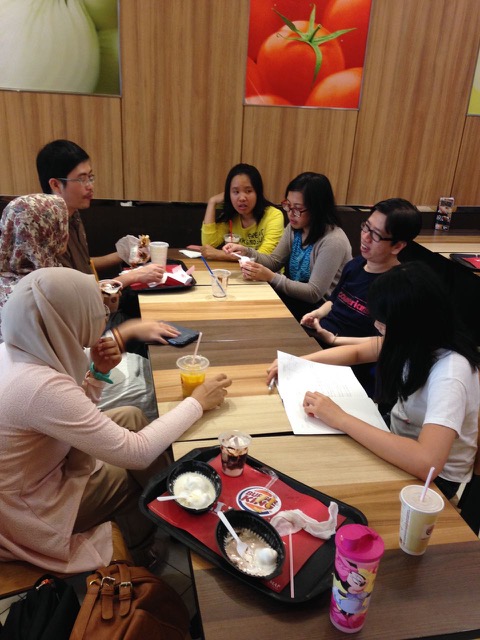
As you know, I joined MOOC ( Massive Open Online Course) courses. Some Indonesian Courserian made this coumunity: id.Courserian. I joined this community last year when I was 10 years old. I'm still the youngest member until now. All the members come from various backgrounds. The ones who joined here in this meetup were proffessionals and some were university students.

The meetup was held every once a month, but I could not always join it. This time it's held on September 18th, 2015, and I shared them all about what I learned about dinosaurs from Dino 101, as the topic says it's Dino 101, one of the courses in Coursera. Underneath was me sharing:

With my notebook.
The whole view fom above.

Our discussion


Monday, 21 September 2015

An Elegant Evening in Batavia Marina

I was invited to my granduncle AB. Susanto's 65th birthday party and book launching of his new book "Potrait of an Ordinary Person Loved By God." It was  held in Batavia Marina, Ancol, where the building is right next to a harbour for goods. First we had a mass, and I played the opening song "Kasih Dari Surga" on the grand piano. Below is the picture of the mass. 


And this is the board at the front of the party showing the book he's launching.

After the mass, I played several songs that I had prepared for this day while the guests explored around and chat with their friends. The violinist joined me.

The violinist had to go, so I played alone.


This is the party outside with a "Sunda Kelapa"cruise as a background.

This is me with the boats out there.
 And this is the gamelan at the entrance. After playing the piano I and my father went around and took pictures.
This is the stairs at the entrance.


Tuesday, 8 September 2015

The Story of Prometheus

The good titan, Prometheus, that I had mentioned before in the Coming of the Greek Gods, was asked by Zeus to create man out of clay, and teach them how to live on earth, the basics of life, and the gifts of everything. But he might not give them the gift of fire, for that belonged to the gods. Without fire, teaching mankind and mankind's life became hard and slow work. If he gave fire to mankind, he would surely be punished by Zeus. But he had to give them, to make the job faster. So before he gave fire to mankind, he asked his good brother titan Epimetheus, to take care of them when he was punished by Zeus. Finally Prometheus gave fire to mankind and was punished by Zeus.

Zeus punished Prometheus by chaining him onto a rock and everyday an eagle would come and ate his liver. But then it would grow again and the next day the eagle would eat it again. Repital. But Prometheus told Zeus that the giants would one day overthrow him, and only he (Prometheus) knew the solution. Only he won't tell until he was realeased. Zeus had no intention realeasening Prometheus, so Prometheus didn't tell Zeus. (He would be released in another Greek myth)

http://www.theoi.com/Titan/TitanPrometheus.html

Tuesday, 1 September 2015

How Smart Hermes Was.

Hermes was the son of Zeus and a mortal woman named Maia. He was the gods' messenger, and also sent the dead souls to the underworld. This is the statue of Hermes:
Hermes Ingenui Pio-Clementino Inv544.jpg
https://en.wikipedia.org/wiki/Hermes


This is a famous myth about how smart Hermes was:

When Hermes was a little boy, a toddler age, he went to steal Apollo's 50 cows for fun. Apollo was a god, but a sheperd too.  He threw away his own sandals and made another, with the straps on the place where the heels should be. So when he walked, his tracks were showing backwards. He also brought and pulled the cows backwards, so that Apollo would not recognize the tracks and go the wrong way. He passed an old man and gave him several cows, telling him not to tell anyone if he passed. But he didn't trust the old man so a little time later, he dressed as a traveller and asked the old man if a little kid went this way. The old man told the truth, and so Hermes with rage changed the man into stone. Then he brought the cattle towards where he lived: a cave. Soon it became night and Hermes killed 2 cows, and divided it as an offering to the 12 gods, (except Apollo, of course, so the twelfth is for him), then continued on his way towards the cave. He hid the cows there. 

When Apollo found out that his cattle had been stolen, he tried to track it but wasn't able to. When he found out that it was Hermes who stole it, he went to the cave and found Hermes there. Hermes just looked at him with an innocent face, and when Apollo accused him for stealing the cattle, Hermes just said that he (Hermes) was still a toddler, how could he steal 50 cows all on his own? After argueing, Apollo brought Hermes to Zeus. Zeus was ammused by Hermes's theft, but asked him to confess his mistake. So finally Hermes confessed his mistake and showed Apollo what he just did. Then he played the lyre that he just made and learned how to play, and Apollo really wanted that lyre. So he traded his cattle wih Hermes for the lyre, and also gave him the Herald's Golden Staff, which was one of his symbols now. The other one was the winged sandals that Zeus gave him for he was the gods' messenger. Afther this exchange Apollo became the god of music, and Hermes became a shepperd, like Apollo's job before. 

https://xsmyth2012.wikispaces.com/Hermes
                       That's the end of the famous myth of Hermes.