Pages

Showing posts with label Ancient Greek. Show all posts

Monday, 30 November 2015

Parthenon Part 4: The Later History of the Parthenon (Last Part)

After the middle or third century AD, a fire broke out in the Parthenon, destroying the roof and much of the interior. Some pirates also sacked Athens, destroying the buildings, including the Parthenon. Repairs were made in the fourth century AD, but they did it incorrectly.

One day in 435 AD a king named Theodosius II decreed that all pagan temples from the Byzantine Period be closed and that includes the Parthenon. Somewhere between the 5th century, the Athena statue (read Parthenon Part 1) was stolen and brought somewhere, where it was destroyed.

It was then changed into a Christian Church. The shape of the church was changed to face the east, the main door facing the West.

Next, it was changed into a mosque when the Ottoman Turks arrived. Although the Parthenon had been changed into a church and then a mosque, the basic shape and structure is still intact. Here's a picture of the Parthenon as a mosque:

https://en.wikipedia.org/wiki/Parthenon

 The Parthenon was then destructed enourmously when the Venetians led by Francescoe Morosini, attacked Athens and captured the Acropolis. A Venetian mortar round fired and blew up part of the Parthenon. It caused large fires that burned an amount of buildings.

But now the Parthenon is being restored really carefully. The scientists are pretty confused of how to make it exactly like how the Ancient Greeks did. Now it is still in the process.

Tuesday, 13 October 2015

The Parthenon Part 3: The Collumns of the Parthenon

Here I'm going to tell you about the collumns of the Parthenon. The collumns are in the Doric Order. Below is a doric order collumn:

First let me tell you about the orders. They're quite complicated to explain. In total, there are 5 types of column orders: Doric Order, Ionic Order, Corinthian Order, Tuscan Order and Composite Order. The Doric, Ionic, and Corinthian, are from the Greeks, while the Tuscan and Composite are from the Romans. They're all classical orders.The doric order is the oldest order, and the simplest one.

We'll talk starting from the top fo the collumn. The triglyph comes from the word tri, which means "three", and glyph, which means mark, so triglyph means three marks. You can see three lines there up in the picture.

The space between the triglyphs are called metopes, which are often filled with sculptures.

The abacus, or the slab at the top of the collumn is just simple.
https://www.pinterest.com/pin/145381894195548785/
Now we go to the tricky part. Most people think that the collumns are straight, but actually they're not. From the top towards the middle, the width grows bigger, then towards the bottom, it tapers, which means the width becomes smaller.  So the widest point is at the middle, and the thinnest point is at the top. The collumn is not carved out of one stone, they're carved from different stones. They put them together by making a hole at the centre of the already-carved stones, so that a piece of wood will string them together. 

It's quite fascinating because the Ancient Greeks made the shaft have a sense of elasticity, making it able to bear the weight above it, and design it not only using math and geometry, but also with human perception, because the further we go, the smaller something is. 

This is the end of Parthenon Part 3


Tuesday, 8 September 2015

The Story of Prometheus

The good titan, Prometheus, that I had mentioned before in the Coming of the Greek Gods, was asked by Zeus to create man out of clay, and teach them how to live on earth, the basics of life, and the gifts of everything. But he might not give them the gift of fire, for that belonged to the gods. Without fire, teaching mankind and mankind's life became hard and slow work. If he gave fire to mankind, he would surely be punished by Zeus. But he had to give them, to make the job faster. So before he gave fire to mankind, he asked his good brother titan Epimetheus, to take care of them when he was punished by Zeus. Finally Prometheus gave fire to mankind and was punished by Zeus.

Zeus punished Prometheus by chaining him onto a rock and everyday an eagle would come and ate his liver. But then it would grow again and the next day the eagle would eat it again. Repital. But Prometheus told Zeus that the giants would one day overthrow him, and only he (Prometheus) knew the solution. Only he won't tell until he was realeased. Zeus had no intention realeasening Prometheus, so Prometheus didn't tell Zeus. (He would be released in another Greek myth)

http://www.theoi.com/Titan/TitanPrometheus.html

Tuesday, 1 September 2015

How Smart Hermes Was.

Hermes was the son of Zeus and a mortal woman named Maia. He was the gods' messenger, and also sent the dead souls to the underworld. This is the statue of Hermes:
Hermes Ingenui Pio-Clementino Inv544.jpg
https://en.wikipedia.org/wiki/Hermes


This is a famous myth about how smart Hermes was:

When Hermes was a little boy, a toddler age, he went to steal Apollo's 50 cows for fun. Apollo was a god, but a sheperd too.  He threw away his own sandals and made another, with the straps on the place where the heels should be. So when he walked, his tracks were showing backwards. He also brought and pulled the cows backwards, so that Apollo would not recognize the tracks and go the wrong way. He passed an old man and gave him several cows, telling him not to tell anyone if he passed. But he didn't trust the old man so a little time later, he dressed as a traveller and asked the old man if a little kid went this way. The old man told the truth, and so Hermes with rage changed the man into stone. Then he brought the cattle towards where he lived: a cave. Soon it became night and Hermes killed 2 cows, and divided it as an offering to the 12 gods, (except Apollo, of course, so the twelfth is for him), then continued on his way towards the cave. He hid the cows there. 

When Apollo found out that his cattle had been stolen, he tried to track it but wasn't able to. When he found out that it was Hermes who stole it, he went to the cave and found Hermes there. Hermes just looked at him with an innocent face, and when Apollo accused him for stealing the cattle, Hermes just said that he (Hermes) was still a toddler, how could he steal 50 cows all on his own? After argueing, Apollo brought Hermes to Zeus. Zeus was ammused by Hermes's theft, but asked him to confess his mistake. So finally Hermes confessed his mistake and showed Apollo what he just did. Then he played the lyre that he just made and learned how to play, and Apollo really wanted that lyre. So he traded his cattle wih Hermes for the lyre, and also gave him the Herald's Golden Staff, which was one of his symbols now. The other one was the winged sandals that Zeus gave him for he was the gods' messenger. Afther this exchange Apollo became the god of music, and Hermes became a shepperd, like Apollo's job before. 

https://xsmyth2012.wikispaces.com/Hermes
                       That's the end of the famous myth of Hermes.

Tuesday, 25 August 2015

Parthenon Part 2: The Parthenon Frieze, and the Parthenon In Colour.

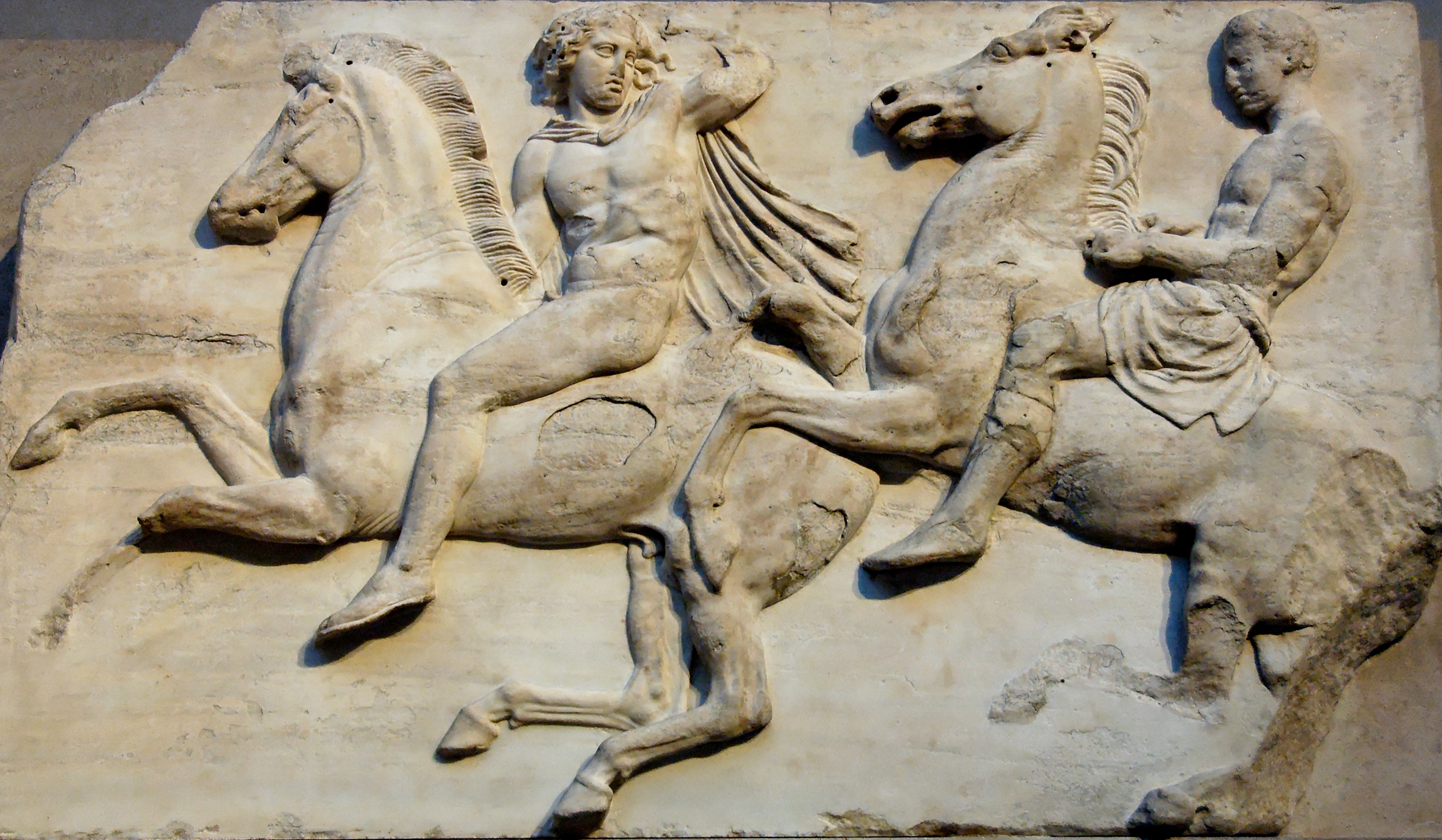
I have written about Parthenon Part 1, and now it's Parthenon Part 2! Here I'm going to write about the friezes, made out of marbles in the temple, which lined up on the walls, and also the marble sculptures in the Parthenon. Friezes are carved stone walls, like this:

https://en.wikipedia.org/wiki/Parthenon_Frieze
The friezes stories were taken from myths, mythical battles, and stories of heroes. The one in the left is a picture of a battle leader on horse waving his hand to say stop to his assistant. They walled up the walls in the Parthenon. 
http://www.athensguide.org/the-elgin-marbles-of-pathenon.html
                        
There are sculptures in the Parthenon too. These are the marble statues in the British Museum, taken from the Parthenon.  

 Now we're going to discuss about the Parthenon In Colour. Usually you see the sculptures and friezes, and temples from Ancient Greece greyish-white. But actually they had colours. They might look strange and much better without colour, because we're used to it. Here's how they look like with colour:

http://linneawest.com/tag/painted-replica
This is how the Parthenon looks like with colour.
And this is how a statue of an archer in colour looks like. Looks strange right? This picture was taken from:
http://www.smithsonianmag.com/arts-culture/true-colors-17888/

This is how Aphrodite, the goddess of beauty and love looks like in colours:

http://www.smithsonianmag.com/arts-culture/bringing-the-color-back-to-ancient-greece-80032254/

The scientists found out that the statues' colours by using an imaging technology called photo-induced luminescence to find the specks of pigment. Also by using infra-red light on it, it showed Egyptian blue colour, which is often found on the statues, such as on the belt of Poseidon's messenger Iris, and on the cloak of goddess Dione. 

http://www.dailymail.co.uk/travel/article-2676413/Athenss-Acropolis-Museum-celebrates-fifth-anniversary-digital-programme-colour-Parthenon-Marbles.html
                              This is one of the frieze in colour.

As time passes, the colours from the statues, buildings, and friezes faded away. These are some reasons why the Parthenon's colours faded away: because of war, changed into a church and mosque, and destroyed. That is also why you see the Parthenon in ruins now.

To be continued.

Sunday, 16 August 2015

The Coming of the Greek Gods


http://www.talesbeyondbelief.com/greek-gods/zeus.htm

I wrote the beginning of Egypt's gods, godesses, and Egypt's myth here. Now, I'm going to tell you about the myth of the beginning of Greek's gods and godesses. The story was told before writing was made, so it was passed down orally, and sometimes the story got mixed up. Greece has many places, such as Athens, Sparta, and Olympia (that's well known for the place where the gods dwell), and if people from those places meet together and retell the story, all of them will be confused. Some people will say "Leto is Zeus's wife", while some say "No! Hera is Zeus's wife." In the ancient times, man used to have many wives, with the first as the chief wife, so finally it was concluded that Zeus had many wives, and it was known that Hera was the chief wife.

Let's Start.
First, there was chaos all around. Then night and Erebus (darkness) were born, where death dwells. From them, love was born, Love created light and day. The first creatures born from it were Gaia (mother Earth) and Uranus (father Heaven). They had children who were the Hechatocheires ( monsters with fifty heads) , Cyclopses, and Titans. There were many Titans, and one of the Titans was Kronos. Kronos looked really gigantic (as how Titans did) and had a sickle, and with that sickle he wounded his father Uranus. From Uranus's blood that spilt into the land, there formed the giants and also his blood that spilt into the sea formed Aphrodite. Below was Kronos wounding Uranus.

http://www.the-dreamweaver.net/portal/en/articles/2-uncategorised/41-the-cycles-of-saturn-and-uranus
After that, Kronos ruled the world and married his sister Titan Rhea. His parents told him that one of his children would dethrone him, as how he dethroned his father. So, everytime his child was born, he would eat them. His children were: Hera, Demeter, Hades, Poseidon, Hestia, and Zeus. But all of them were eaten by Kronos, except Zeus, whom Rhea hid in a cave in Crete with the nymphs there to take care of him. Mother Earth Gaia also took care of him. The other smaller gods and soldiers clanged their swords when Zeus cried, so that Kronos would not hear Zeus's cry. After Zeus was hidden, Rhea wrapped a stone with baby clothes and gave it to Kronos to eat, making Kronos think that he had eaten Zeus.

Zeus grew up into an adult there, and with the help of a good Titaness Metis (or thought) who created a poisonous drink, made his father Kronos to vomit out all of his siblings. Then with the help of the Cyclops, (giants with one eye in the middle of the forehead), ten years Zeus and all of the inhabitants fought, and finally Zeus managed to put Kronos and the bad Titans in a prison under the earth called Tartarus.  


http://atlanteangardens.blogspot.com/2014/04/war-of-gods-and-titans.html
Only, not all Titans fought and not all Titans were bad. The sea itself was a Titan, and others too, who were kind and really helpful, such as Selene, the moon, and even Metis was a Titan, which we will discuss later. There were some other Titans too. The kind Titans who helped them were not put into Tartarus.

One of the Titan that was sent down to Tartarus had three sons, Atlas, Prometheus, and Epimetheus. Atlas was as wicked as his father, and he really looked like a Titan, so Zeus punished him by making him carry the world on his back (because he's wicked), while the other two would help Zeus manage the land.

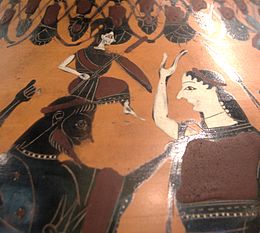
In the middle of the battle, Zeus fell in love with Metis, but he heard that the child that Metis would have would overpower him. Metis could change into any form, and Zeus tricked her to change into a fly. Then Zeus swallowed her. Eventually, he got a terrible headache, and asked someone to cut his head (Gods couldn't die) and out came Athena fully armed with clothes, a shield, and a spear. But she had no notion of overpowering her father. That's why in friezes, you can see Athena fighting the Titans. She killed a bad Titan named Pallas, and added his name into hers, so her name became Pallas Athena. Below is the picture of Athena coming out of Zeus's head on an ancient Greek pot.
https://en.wikipedia.org/wiki/Athena
https://www.studyblue.com/notes/note/n/arth-exam-2/deck/10710897
      And this is Athena fighting the titans. The head was stolen.

After the battle was won, they decided who would rule the air, the sea, and the rest. So it was decided that Zeus would rule over the whole Gods, Hades over the Underworld, Poseidon over the Sea, Hera (Zeus's wife) as the protector of women and marriage, Hestia, the goddess of the hearth, as hearth was very important to the Greeks, because fire was really important back then, and Demeter, the goddesss of the harvest.


That's the end of the myth.


Sunday, 26 July 2015

The Pathenon Part 1: Why Is The Land Called Athens, and the Story of the Pictures On the Parthenon Roof.

I learned about ancient history from various of MOOC, which are Khan Academy, Coursera, and edX. From Khan Academy, I learned about the Pathenon. And I'd like to share some of my knowledge about the Parthenon in this blog.

These pictures are from the internet, because I've never been to Greece.The Parthenon was built in Athens, Greece, and the picture above is how it should look like. It's the replica. But the real one is like this:

http://www.shunya.net/Text/Herodotus/images/Parthenon.jpg
I'll write The Parthenon in some parts, and this is the introduction. The Parthenon is a temple dedicated to the goddess Athena, who is the goddess of wisdom, courage, inspiration, civillization, law and justice, mathematics, strength, war strategy, and arts and crafts. And they dedicated this temple to her, and named the land Athens. This is how the myth goes, Poseidon and Athena wanted that land, which was previously named Attica, and the people didn't know which to choose. Poseidon is the god of the seas. So each god decided to give the citizens a gift, and the citizens were to choose which gift they liked, and then the god or goddess who mad that gift will be picked. Poseidon gave them a well which was filled with saltwater and would make them win any battle on sea. But Athena gave them an olive tree, and they could eat its fruit, they could use its wood for firewood, and they could use the oil for the light. So the citizens chose her, and they made this temple for her.

Inside the temple, there's a giant gold Athena statue, but now it's gone because of wars, earthquake, and other things. At the top of the roof, there are pictures of Athena and Poseidon fighting. 
image
https://slowpainting.wordpress.com/2009/06/28/parthenon-and-color/


Athena is at the left side, and Poseidon is at the right side. The roof is a replica too. And below is the replica of the gold statue of Athena:


Statue of Athena
http://www.nashville.gov/Parks-and-Recreation/Parthenon/Athena.aspx

And that's the end of Part 1. Thank you for reading.


To be continued.