Hoax is a well known word around the world. It has great influence in people’s life and community. It had misled people, caused unrests, and even death. There are many different types of hoax. Some hoaxes are about politics or a certain tribe/religion/race/etc. Others about safety, health, food, and education. To avoid disruption in our lives and societies, we social media users must be active in preventing hoaxes.
False health information may also lead people to spend up to hundreds of dollars to buy something utterly useless for their health. People may not trust their doctors anymore and continue to be guided by the internet. This can be dangerous, as they may never know who is really behind the news.
Hoaxes may also be used to put down competitors, such as another company or political candidates. Misleading news about other candidates may lead us to pick someone who doesn’t benefit our city/state/country. This is such a waste, as we could’ve made plenty of improvements during that leader’s era. Different supporters may also end up having a war with the other about their leader of choice, and this would lead to the spread of unnecessary hatred.
In October 2018, an image of a woman’s bruised and abused face sparked a lot commotion among Indonesian netizens. It was said to be the face of Ratna Sarumpaet. The post said that she was beaten by some people. Ratna Sarumpaet is in the winning team of a presidential candidate, and the people from that presidential candidate’s political party confirmed it. Even the presidential candidate himself confirmed it. As it’s nearing the president election, people could easily assume that the attack was made by the other presidential candidate’s political party. After some investigations made by the police, it was revealed that Ratna Sarumpaet actually just had some plastic surgery.
Whenever we receive information through social media, the first thing most of us do is: forward and share! This habit must be avoided! That’s actually the last thing we should do. The foremost action we should take is cross-checking & researching. We could cross-check by googling some keywords from the article/information and see whether similar news/information show up at other reliable sites such as CNN.com, Kompas.com, etc. Additionally, nowadays, there are many websites dedicated to battling hoax such as Snopes or Detik.com’s hoax or no hoax site.
If we find out that the information we receive is a hoax, we should attempt to stop it by informing the sender that the message they sent was a hoax. To avoid misconceptions, we could remind them to inform others too. We could also report the fake news to the administrator of the social media. Most social media platforms have functions to allow users to report fake news easily.
Hoax could be dangerous and fatal once it spreads everywhere, especially with almost everyone having access to social media. Both young and old might just believe in anything from social media and take immediate actions without checking the facts. So watch out for any fake news and do your roles in getting rid of hoax!
Thursday, 21 March 2019

Wednesday, 23 January 2019
Is War Ever Right
It would seem that wars have always existed side by side with human civilization. They are horrible events full of bloodshed. Some wars’ purpose is to conquer other countries, some to obtain the natural resources of others, some to spread religion, and some to defend themselves. Whatever the reasons are, the destructions and casualties are significant. Therefore I highly urge for all future war plans to be reconsidered and substituted with more peaceful solutions.
Wars are not necessary. There are always a lot of solutions to a problem. It should be avoided as best as we could. Starting a war would be the worst choice anyone could choose. First of all, war costs a lot of money. Instead of spending money to kill and destroy, wouldn’t it be better to spend them on constructive things such as for the benefits and welfare of the citizens. We would also have more funds to help other countries, and build friendly relationships with them, thus eliminating the needs of war.
War also bring heartaches and griefs. It tears families and friends apart. The aftermath of the Korean War is a living proof of this. Some family members were forever separated after Korea separated into South Korea and North Korea. War endangers a country’s future. Soldiers who came back from wars are often times disturbed and needs a lot of counselling to be able to live normally. They could be disillusioned by what they saw in war that they become unstable and cause further damage in their community.
With so many downsides of wars, a more peaceful alternative to solve conflict is preferable. In the course of history, some examples of successful peaceful actions are boycotting or practising civil disobedience, which had been carried out by Rosa Parks and Mahatma Gandhi.
During the British colonization of India, India citizens were treated unfairly and unequally. Mahatma Gandhi, who was a lawyer at that time, was deeply disturbed and wanted to abolish these inequalities. Gandhi adopted peaceful methods to reach his goals. He frequently made speeches about the inequalities and encourage Indians to fight against them. However, he advocated for a non-violent rebellion. His first method was to encourage the British during hard times, such as when Britain was at war. He hoped that the British would consider the Indians their allies, and change their racist views of Indians. Unfortunately though, this method did not work, and the British continued to treat Indians unfairly.
Then, Gandhi persuaded the Indians to do peaceful civil disobedience and boycott British products. This angered the British and they opened fire at them as a punishment. This resulted with some of the Indians rioting. Despite it all, Gandhi still continued to persuade the Indians not to resort to violence. Had it not been for Gandhi, the Indians would have returned fire themselves. Gandhi continued to hold non-violent demonstrations, boycotting, and negotiation with the British government until India was finally granted Independent in 1947.
Another example is Rosa Parks. She experienced inequality as a black woman and wanted to put an end to it. She inspired a lot of coloured people to rebel when they were treated unfairly, such as not submitting to the rule that they must sit in an assigned area in the bus. Her actions, prompted a lot of the Black communities to refuse to submit to prejudice by simple acts of not using the bus and do carpool instead or refusing to sit in the assigned area. At the end of the boycott, the Supreme Court of Montgomery decreed for the segregation bus law to be abolished.
Those two examples showed that we could do peaceful demonstrations and raise awareness of the problems that we’re facing. Violence or war are definitely avoidable. To resolve conflicts, the main goal is always to raise awareness and then negotiate for solutions. Nowadays, the ever growing social media is a superb method for raising awareness. It’s also a great medium to discuss the problems. Considering the great losses of wars, it would be more beneficial for all parties to find more harmonious solutions.
War also bring heartaches and griefs. It tears families and friends apart. The aftermath of the Korean War is a living proof of this. Some family members were forever separated after Korea separated into South Korea and North Korea. War endangers a country’s future. Soldiers who came back from wars are often times disturbed and needs a lot of counselling to be able to live normally. They could be disillusioned by what they saw in war that they become unstable and cause further damage in their community.
With so many downsides of wars, a more peaceful alternative to solve conflict is preferable. In the course of history, some examples of successful peaceful actions are boycotting or practising civil disobedience, which had been carried out by Rosa Parks and Mahatma Gandhi.
During the British colonization of India, India citizens were treated unfairly and unequally. Mahatma Gandhi, who was a lawyer at that time, was deeply disturbed and wanted to abolish these inequalities. Gandhi adopted peaceful methods to reach his goals. He frequently made speeches about the inequalities and encourage Indians to fight against them. However, he advocated for a non-violent rebellion. His first method was to encourage the British during hard times, such as when Britain was at war. He hoped that the British would consider the Indians their allies, and change their racist views of Indians. Unfortunately though, this method did not work, and the British continued to treat Indians unfairly.
Then, Gandhi persuaded the Indians to do peaceful civil disobedience and boycott British products. This angered the British and they opened fire at them as a punishment. This resulted with some of the Indians rioting. Despite it all, Gandhi still continued to persuade the Indians not to resort to violence. Had it not been for Gandhi, the Indians would have returned fire themselves. Gandhi continued to hold non-violent demonstrations, boycotting, and negotiation with the British government until India was finally granted Independent in 1947.
Another example is Rosa Parks. She experienced inequality as a black woman and wanted to put an end to it. She inspired a lot of coloured people to rebel when they were treated unfairly, such as not submitting to the rule that they must sit in an assigned area in the bus. Her actions, prompted a lot of the Black communities to refuse to submit to prejudice by simple acts of not using the bus and do carpool instead or refusing to sit in the assigned area. At the end of the boycott, the Supreme Court of Montgomery decreed for the segregation bus law to be abolished.
Those two examples showed that we could do peaceful demonstrations and raise awareness of the problems that we’re facing. Violence or war are definitely avoidable. To resolve conflicts, the main goal is always to raise awareness and then negotiate for solutions. Nowadays, the ever growing social media is a superb method for raising awareness. It’s also a great medium to discuss the problems. Considering the great losses of wars, it would be more beneficial for all parties to find more harmonious solutions.
Tuesday, 18 December 2018
About Jobs
In our life, I’m sure that everyone wants a job that they love, but at the same time, get well paid for it. Unfortunately though, that is just a dream to a lot of people. We often meet people who have a really high position in their workplace and a really high salary, but at the same time are stressed and unhappy. There are also people who have a job that they really enjoy, but do not earn much. As our time on earth is precious, I would prefer to have a job that I enjoy so that I could have a good life.
As most people will tell you, time is precious. We need to make good use of our time. Why spend so much of our limited time on things that do not make us happy and gives us so much pressure. A lot of us work every day except on Sundays, which shows just how much we work for the sake of earning money. Then on Sundays, we might be too tired to do anything except for resting. Why should we spend a lot of our time on things that do not satisfy or make us happy?
If we’re not happy at work, often times we will bring the unhappiness back home. When we are tired, our mind won’t be able to think well. We will lash out at every little thing. The atmosphere will be unpleasant. This may make our family members or anyone living with us wary. Our relationship with family members will also deteriorate.
If we are stress or unhappy for a long time, it may give us health problems. It has been discovered that stress can lead to sicknesses such as cancer. Instead of having a lot of money from our high income, we waste a lot of money on medical bills. Is this all really worth it just for the sake of earning money for our living?
There will always be obstacles and hardships in any job that we take. When we have a passion for somethingthat we love, we have the motivation to always try our best when facing obstacles, no matter how hard it is. We will always try to improve ourselves and our jobs too. Thus, we will be able to grow in our career faster. On the other hand, when we encounter a setback while doing a task that we dislike, it will be harder for us to solve it because we lack enthusiasm.
Why should we pressure ourselves with earning a lot of money? It’s not worth it. As long as we are able to earn enough for our living and some extras. Money isn’t everything, and we cannot buy happiness. Those who chose the jobs that they like will have a much happier life. Even if they don’t make much money, they will at least be able to earn enough for their lives. Those who don’t like their jobs might earn much more but in reality they dislike their repetitive tiring lives.
As most people will tell you, time is precious. We need to make good use of our time. Why spend so much of our limited time on things that do not make us happy and gives us so much pressure. A lot of us work every day except on Sundays, which shows just how much we work for the sake of earning money. Then on Sundays, we might be too tired to do anything except for resting. Why should we spend a lot of our time on things that do not satisfy or make us happy?
If we’re not happy at work, often times we will bring the unhappiness back home. When we are tired, our mind won’t be able to think well. We will lash out at every little thing. The atmosphere will be unpleasant. This may make our family members or anyone living with us wary. Our relationship with family members will also deteriorate.
If we are stress or unhappy for a long time, it may give us health problems. It has been discovered that stress can lead to sicknesses such as cancer. Instead of having a lot of money from our high income, we waste a lot of money on medical bills. Is this all really worth it just for the sake of earning money for our living?
There will always be obstacles and hardships in any job that we take. When we have a passion for somethingthat we love, we have the motivation to always try our best when facing obstacles, no matter how hard it is. We will always try to improve ourselves and our jobs too. Thus, we will be able to grow in our career faster. On the other hand, when we encounter a setback while doing a task that we dislike, it will be harder for us to solve it because we lack enthusiasm.
Why should we pressure ourselves with earning a lot of money? It’s not worth it. As long as we are able to earn enough for our living and some extras. Money isn’t everything, and we cannot buy happiness. Those who chose the jobs that they like will have a much happier life. Even if they don’t make much money, they will at least be able to earn enough for their lives. Those who don’t like their jobs might earn much more but in reality they dislike their repetitive tiring lives.
Thursday, 29 November 2018
Chromatography With Natural Colours
Out of curiosity, I wanted to know if the colours in nature are made up of different colours too. So I decided to do chromatography on flowers, using this website as a guide.
Initially, I wanted to use the flowers hibiscus and Clitoria Ternatea for my experiment. Unfortunately though, I couldn't find the latter and so had to walk around my neighbourhood to find for other flowers. There were a lot of pink flowers, but according to the website, pink flowers may not work well. In the end, I found 2 red flowers (Hibiscus and Maule's Quince ), red Plumeria and Allamanda.

Materials:
- Flowers
- Filter paper
- Alcohol
- Clear glass jars
- Spoon/anything hard to crush the flowers
- Scissors
First, I crushed some of the Hibiscus petals using the spoon in the middle of the filter paper. I did this to take the pigments out. I expected red to come out, but surprisingly, a purplish colour went out instead. It's kind of wet, so I left it out to dry for a while.


While waiting for the hibiscus colour to dry, I crushed all the Allamanda petals. I forgot to leave a petal or 2 out to show you the flower.

Next I crushed the Maule's Quince petals. As it's really red, the purple colour that came out was much stronger than the Hibiscus's.

After that, I crushed the red Plumeria. If you see the petals, there is the colour yellow, but no yellow pigment came out, only the purple one. It's not as strong as the other purples, though.

I then cut a strip from the edge of the circle to the pigments. After filler the glass cups with water and some alcohol, I dipped the strip into the water. Next up is waiting!
From left to right, top to bottom: Hibiscus, Maule's Quince, red Plumeria, Allamanda.

After waiting for half an hour or more, these are the results I got:
From what I observed in the experiment, the red from the Hibiscus was made up of purplish brown and yellow, while the red Plumeria was made up of faded purple, faded yellow, and brownish yellow. The Maule's Quince was made up of purple, yellow, and a tiny bit of brownish yellow, and the Allamanda was made up of brown.
Conclusion:
When compared to the synthetic colours in the previous post, the natural colours aren't as strong as the synthetic ones. The colours that made up the synthetic ones mostly true to their colours; red is made up of red and pink, green is made up of green and a tiny bit of blue. However, in the case of colors from nature, the colours separated may not be the colours we originally see. The red in the Hibiscus and Maule's Quince was not made up of red, pink, or any colours that are close to it but purplish brown and yellow.
The colours of the flowers were really bright, but when mixed with water and separated, I observed that the colours are dark and dull and it seemed to always contained some brown. Meanwhile, the synthetic colours didn’t change much; they still have their brightness and colour. This might be because the particles of the natural colours dissolve in the water, while synthetic colours are synthetically made to retain its original colour.
Initially, I wanted to use the flowers hibiscus and Clitoria Ternatea for my experiment. Unfortunately though, I couldn't find the latter and so had to walk around my neighbourhood to find for other flowers. There were a lot of pink flowers, but according to the website, pink flowers may not work well. In the end, I found 2 red flowers (Hibiscus and Maule's Quince ), red Plumeria and Allamanda.

Materials:
- Flowers
- Filter paper
- Alcohol
- Clear glass jars
- Spoon/anything hard to crush the flowers
- Scissors
First, I crushed some of the Hibiscus petals using the spoon in the middle of the filter paper. I did this to take the pigments out. I expected red to come out, but surprisingly, a purplish colour went out instead. It's kind of wet, so I left it out to dry for a while.


While waiting for the hibiscus colour to dry, I crushed all the Allamanda petals. I forgot to leave a petal or 2 out to show you the flower.

Next I crushed the Maule's Quince petals. As it's really red, the purple colour that came out was much stronger than the Hibiscus's.

After that, I crushed the red Plumeria. If you see the petals, there is the colour yellow, but no yellow pigment came out, only the purple one. It's not as strong as the other purples, though.

I then cut a strip from the edge of the circle to the pigments. After filler the glass cups with water and some alcohol, I dipped the strip into the water. Next up is waiting!
From left to right, top to bottom: Hibiscus, Maule's Quince, red Plumeria, Allamanda.

After waiting for half an hour or more, these are the results I got:
 |
| Hibiscus and red Plumeria. |
 |
| Maule’s Quince and Allamanda |
Conclusion:
When compared to the synthetic colours in the previous post, the natural colours aren't as strong as the synthetic ones. The colours that made up the synthetic ones mostly true to their colours; red is made up of red and pink, green is made up of green and a tiny bit of blue. However, in the case of colors from nature, the colours separated may not be the colours we originally see. The red in the Hibiscus and Maule's Quince was not made up of red, pink, or any colours that are close to it but purplish brown and yellow.
The colours of the flowers were really bright, but when mixed with water and separated, I observed that the colours are dark and dull and it seemed to always contained some brown. Meanwhile, the synthetic colours didn’t change much; they still have their brightness and colour. This might be because the particles of the natural colours dissolve in the water, while synthetic colours are synthetically made to retain its original colour.
Wednesday, 28 November 2018
Chromatography With Synthetic Colours
Recently, I learned about chromatography in my O Level Chemistry. Chromatography is the separating of the colours that are in a chemical mixture using water on a filter paper. One of its uses is to check if the colouring used does not contain any banned chemical.
There were 2 choices of how I could set up the experiment in my chemistry book, by using either a circular filter paper or just using a strip of it. I decided to use the circular one, because I have that filter paper. Cutting just a strip out of it would be a waste. It's also easier to set up for me.
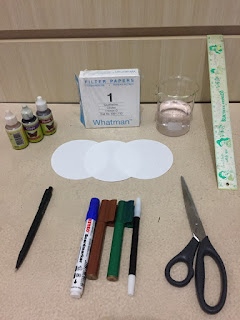
Materials:
- Beaker/see-through glass
- Filter paper
- Food Colours (the chemical I want to experiment with)
- Markers (the chemical I want to experiment with)
- Ruler
- Pencil
- Scissors

First, I filled the beaker with water (around 250 ml), then dotted the middle of the filter paper with purple food colour. I then cut a strip of the filter paper, 1 cm wide, from the edge of the paper to the centre. Unfortunately, though, my dot was too big, so I couldn't use it. The water won't be able to separate the colours well if it's too big; I need a bigger filter paper for the colours to separate.

So I repeated the steps above, except with a smaller dot. I fold the strip of paper down in the middle and put the filter paper on top of the beaker, making sure that the end of the strip of paper touches the water. The water will soak the paper, and will move up the paper. When it touches the ink, it will separate the colours as it spreads out on the filter paper.

My food colouring has never been used for years, so some of the food colour around the bottle dropper had dried and became powder-like. Some of the powder fell on the strip, and when they got the water, they spread out as pink. You can see it in the picture on the right.
After waiting for around 15 minutes, I started to see a reaction. The first colour that I saw spread out was red, then a little bit of blue. This is how it looks like after I waited a bit longer, around 15 minutes later:

Next, I tried the red food colour:
I made the dot too big, but at least it isn't as big as my first dot at the start of this experiment.
This is how it looked like after 30 minutes:

The only colour I see in this food colour is red. After that I decided to do several colour tests together so that I save time. Otherwise I had to wait around 30 minutes for each test to finish and I wanted to do a lot of colour tests.

This is what happened around 30 minutes later.

A closer look:
I wasn't satisfied with the colour spread of the blue marker, so I decided to change markers. This is the result of my second experiment:
I noticed that the edges of the colour spread vary. The edges of the colour spread from the food colouring are wavy, while the edges of the markers are round and smooth.
The colour spread of the green and brown marker, red and yellow food colouring is true to its respective colour. Green markers produces green colour, brown markers produces brown colour, red food colouring produces red colour and yellow food colouring produces yellow. Whereas the blue board marker produces blue and pink colours. I thought that this was interesting as I didn’t expected pink in a blue marker.I noticed that blue and pink/red appears a lot. I don't exactly know why, but perhaps it's because they're 2 of the 3 primary colours.
Why do different colours rise to different levels? This is because the particles of each colour have different solubility (how well they dissolve in water). Those which are less soluble and doesn't dissolve in water well aren't easily brought along by the water. While those that are more soluble dissolves better in water and are easily brought along the water as it goes up the paper.
It was pretty fun making this experiment, as I could see all the different colours that make up some food colours and markers. This experiment was also time-effective. I had to wait quite long for the colours to spread, so while waiting, I could do my other studies while waiting.
There were 2 choices of how I could set up the experiment in my chemistry book, by using either a circular filter paper or just using a strip of it. I decided to use the circular one, because I have that filter paper. Cutting just a strip out of it would be a waste. It's also easier to set up for me.

Materials:
- Beaker/see-through glass
- Filter paper
- Food Colours (the chemical I want to experiment with)
- Markers (the chemical I want to experiment with)
- Ruler
- Pencil
- Scissors

First, I filled the beaker with water (around 250 ml), then dotted the middle of the filter paper with purple food colour. I then cut a strip of the filter paper, 1 cm wide, from the edge of the paper to the centre. Unfortunately, though, my dot was too big, so I couldn't use it. The water won't be able to separate the colours well if it's too big; I need a bigger filter paper for the colours to separate.

So I repeated the steps above, except with a smaller dot. I fold the strip of paper down in the middle and put the filter paper on top of the beaker, making sure that the end of the strip of paper touches the water. The water will soak the paper, and will move up the paper. When it touches the ink, it will separate the colours as it spreads out on the filter paper.

My food colouring has never been used for years, so some of the food colour around the bottle dropper had dried and became powder-like. Some of the powder fell on the strip, and when they got the water, they spread out as pink. You can see it in the picture on the right.
After waiting for around 15 minutes, I started to see a reaction. The first colour that I saw spread out was red, then a little bit of blue. This is how it looks like after I waited a bit longer, around 15 minutes later:

Next, I tried the red food colour:
 |
 |
I made the dot too big, but at least it isn't as big as my first dot at the start of this experiment.
This is how it looked like after 30 minutes:

The only colour I see in this food colour is red. After that I decided to do several colour tests together so that I save time. Otherwise I had to wait around 30 minutes for each test to finish and I wanted to do a lot of colour tests.

This is what happened around 30 minutes later.

A closer look:
 |
 |
 |
 |
I wasn't satisfied with the colour spread of the blue marker, so I decided to change markers. This is the result of my second experiment:
 |
| Satisfying |
The colour spread of the green and brown marker, red and yellow food colouring is true to its respective colour. Green markers produces green colour, brown markers produces brown colour, red food colouring produces red colour and yellow food colouring produces yellow. Whereas the blue board marker produces blue and pink colours. I thought that this was interesting as I didn’t expected pink in a blue marker.I noticed that blue and pink/red appears a lot. I don't exactly know why, but perhaps it's because they're 2 of the 3 primary colours.
Why do different colours rise to different levels? This is because the particles of each colour have different solubility (how well they dissolve in water). Those which are less soluble and doesn't dissolve in water well aren't easily brought along by the water. While those that are more soluble dissolves better in water and are easily brought along the water as it goes up the paper.
It was pretty fun making this experiment, as I could see all the different colours that make up some food colours and markers. This experiment was also time-effective. I had to wait quite long for the colours to spread, so while waiting, I could do my other studies while waiting.
Thursday, 22 November 2018
Homeschooling: An Alternative for Education
Recently, homeschooling has become a popular choice among families who are not comfortable with the limitations of formal schooling, my family included. Some people confuse homeschool with flexi school or tutoring. Homeschooling is learning on our own in our home. As for Flexi schools, students study at home but still go to classes organized by the educational organization two to three days a week. Whereas tutoring is having someone come and teach you at your home.
There are also many different home schooling methods. Some followed a method made by Charlotte Mason and there are those who pay for a program where they can get printable modules. Some others, like me, designed our own lessons. There are various more types of homeschooling, but those 3 methods above are the ones that I’m most familiar with. I studied in a formal school up to primary level. Afterwards, I began homeschooling for junior high level. Homeschooling is much more flexible in many aspects, including time management, subjects we learn, teaching methods, etc. Although homeschooling is far from perfect, I think its benefits outweigh its limitations.
I experienced quiet a staggering amount of school tasks when I was in primary school and up till now, I still get plenty of complaints from my former primary classmates about their pile of works. They had to follow the government’s curriculum, which includes a lot of subjects. Students have to study math, science, Bahasa Indonesia, religion, PKN, etc. After school, they still have academic courses (bimbel) to catch up with their school subjects. Additionally, they also must complete tons of projects and study for exams. That leaves no time for them to pursue subjects that they are interested in.
With homeschooling, I had a more flexible schedule compared to my school friends. I only studied the necessary subjects that I need for my life and things that interests me. I study basic lessons such as math to calculate well, science to understand how everything works, language so I can communicate correctly with others, geography and history so I know about the world I live in. I also play music for fun. My average schedule everyday consists of several hours of math, science, and geography. Additionally, I also study English, history, and music as subjects that I have great interest in.
In most schools, students are usually taught in a uniform style. Students’ uniqueness and abilities are not taken into consideration. All students have their own learning styles and talents. Teachers expect students to learn what they teach in the same way and the same pace. This will result in that some students will fail in some subjects because they are not good at it. They will be given extra lessons and pressured to improve their grade. On the other hand, the subjects that the students excelled at will be overlooked because their grade is already good enough to pass. This situation will make the students feel frustrated because they are only drilled to focus to improve their weaknesses. Yes, weaknesses should not be ignored, but it’s the students’ capabilities that should be developed. This will make them excel in what they’re good at; they will not become a “Jack of all trades”. It’s a figure of speech used to call people who are able to do everything, both their weaknesses and strengths, but they are a master of none.
School teaching methods are also usually teacher-centered. Teachers control the subject materials and study pace. They “spoon fed” the lessons to the students; the teacher explain and the students are expected to pay attention. Afterwards, they will be given exercises to do and they will be expected to complete the exercises according to what the teachers have taught. Students are usually not allowed to have different answers or working methods to the exercises.
Meanwhile homeschool is student centered. This means that the children have control (with parent supervision) over their study pace. They have to make their own study schedules and learn the lessons on their own. They are not required to finish learning the lesson within a certain time frame (one hour for example), but the goal is to master and understand the lesson, however long it takes.
A lot of people are still confused about how homeschoolers learn. Well, I just open my textbook and read! I then try to understand the chapters and do the written and practical exercises from the books. When I have trouble understanding my lessons, I proactively find and use other resources to help me. Some of my sources are my parents (they are not teachers), the internet, and books. We have to read and understand the lessons on our own, without a teacher to explain directly to us. We will be more independent problem solvers because we do not depend on just our teachers to help us, but we learn to find different methods to learn until we understand the lessons.
I learned to discipline myself through homeschooling. When I was at school, I did my school tasks mostly out of fear of my teacher. It’s not that my teachers are fierce, it’s just that they are capable of threatening us and are able to give out punishments. Until now, I still have problems with disciplining myself. Back home, there was no one to do those, so I sometimes still wait for my mom’s presence and reminders to study. My parents didn’t threaten and punish me because they want me to be able to control and discipline myself. I often hear comments about how homeschool students lack socialization. This is an ignorant comment. As much as I’d like to be respectful here and not judge other people’s questions, I really find that question annoying. It’s as if because I am a homeschool student, I’m scared of other people and I don’t socialize at all. Homeschool students have more flexibility in socializing than school students. We learn to socialize in different kind of situations and with people of all ages, not limited to just students our age.
I have learned to make friends with different type of people through my every day activities. I have friends from my homeschool club, workshops that I joined, courses, and events. I also get the chance to meet and talk with my neighbours when I am walking my 3 dogs. They range from as young as 6-7 years old to middle aged adults. I learned different ways to talk with different kinds of people. I’d like to tell you of one of my group of friends. Behind my neighbourhood there is a slum and they often roam around my neighbourhood. Most of them are afraid of dogs and would run off if they see them. Now one morning I was walking my dogs and a group of slum girls took interest in my dogs. They watched from afar and took photos of them, but they still didn’t dare come near us. I told them that my dogs are not fierce and won’t bite and encouraged the girls to pat them if they want to, which they did. They had fun interacting with my dogs and became attached to them. The girls and I also became friends. School students usually have a more limited socialization environment. They usually make friends with classmates their age just because they spend nearly the whole week with them in their classrooms. Aside from that, they might make friends while they attend tuitions outside of school. School children also often suffer from peer pressure, where we have to change ourselves to be accepted by others. A lot of these students don’t know how to interact with people outside of this zone. From my personal experience, usually homeschoolers are more open to people compared to school kids. When I first met my other homeschooler friends, I could feel that they were much more open and friendly. When I participated in homeschool events, the homeschoolers are usually quite happy to meet new friends. In comparison, when I had gymnastics class comprised of all school students, I discovered that the students there have groups, exclusively made out of their own don’t often mingle with students outside their group.
In my country, there is a mandatory national exam to be taken at the end of our primary level, junior high, and senior high. To be able to join the exam, I joined a government institution called a PKBM to have my student number registered. They will take care of student administrations for the exam to the government, and all I have to do are sign some papers. PKBM is a place where homeschoolers who have no resources to learn from can meet up to discuss about their lessons. There are mentors there too to help us out.
Homeschooling is not for everyone. However, for families who think that formal schooling gives negative impacts to their children, homeschooling can be considered as an alternative. There are many ways to learning and receiving education. We can choose the methods that suit us the best. The most important thing though, is that we learn and are happy.
Have you ever seen this funny video about homeschooling? Check it out here!
There are also many different home schooling methods. Some followed a method made by Charlotte Mason and there are those who pay for a program where they can get printable modules. Some others, like me, designed our own lessons. There are various more types of homeschooling, but those 3 methods above are the ones that I’m most familiar with. I studied in a formal school up to primary level. Afterwards, I began homeschooling for junior high level. Homeschooling is much more flexible in many aspects, including time management, subjects we learn, teaching methods, etc. Although homeschooling is far from perfect, I think its benefits outweigh its limitations.
I experienced quiet a staggering amount of school tasks when I was in primary school and up till now, I still get plenty of complaints from my former primary classmates about their pile of works. They had to follow the government’s curriculum, which includes a lot of subjects. Students have to study math, science, Bahasa Indonesia, religion, PKN, etc. After school, they still have academic courses (bimbel) to catch up with their school subjects. Additionally, they also must complete tons of projects and study for exams. That leaves no time for them to pursue subjects that they are interested in.
With homeschooling, I had a more flexible schedule compared to my school friends. I only studied the necessary subjects that I need for my life and things that interests me. I study basic lessons such as math to calculate well, science to understand how everything works, language so I can communicate correctly with others, geography and history so I know about the world I live in. I also play music for fun. My average schedule everyday consists of several hours of math, science, and geography. Additionally, I also study English, history, and music as subjects that I have great interest in.
In most schools, students are usually taught in a uniform style. Students’ uniqueness and abilities are not taken into consideration. All students have their own learning styles and talents. Teachers expect students to learn what they teach in the same way and the same pace. This will result in that some students will fail in some subjects because they are not good at it. They will be given extra lessons and pressured to improve their grade. On the other hand, the subjects that the students excelled at will be overlooked because their grade is already good enough to pass. This situation will make the students feel frustrated because they are only drilled to focus to improve their weaknesses. Yes, weaknesses should not be ignored, but it’s the students’ capabilities that should be developed. This will make them excel in what they’re good at; they will not become a “Jack of all trades”. It’s a figure of speech used to call people who are able to do everything, both their weaknesses and strengths, but they are a master of none.
School teaching methods are also usually teacher-centered. Teachers control the subject materials and study pace. They “spoon fed” the lessons to the students; the teacher explain and the students are expected to pay attention. Afterwards, they will be given exercises to do and they will be expected to complete the exercises according to what the teachers have taught. Students are usually not allowed to have different answers or working methods to the exercises.
Meanwhile homeschool is student centered. This means that the children have control (with parent supervision) over their study pace. They have to make their own study schedules and learn the lessons on their own. They are not required to finish learning the lesson within a certain time frame (one hour for example), but the goal is to master and understand the lesson, however long it takes.
A lot of people are still confused about how homeschoolers learn. Well, I just open my textbook and read! I then try to understand the chapters and do the written and practical exercises from the books. When I have trouble understanding my lessons, I proactively find and use other resources to help me. Some of my sources are my parents (they are not teachers), the internet, and books. We have to read and understand the lessons on our own, without a teacher to explain directly to us. We will be more independent problem solvers because we do not depend on just our teachers to help us, but we learn to find different methods to learn until we understand the lessons.
I learned to discipline myself through homeschooling. When I was at school, I did my school tasks mostly out of fear of my teacher. It’s not that my teachers are fierce, it’s just that they are capable of threatening us and are able to give out punishments. Until now, I still have problems with disciplining myself. Back home, there was no one to do those, so I sometimes still wait for my mom’s presence and reminders to study. My parents didn’t threaten and punish me because they want me to be able to control and discipline myself. I often hear comments about how homeschool students lack socialization. This is an ignorant comment. As much as I’d like to be respectful here and not judge other people’s questions, I really find that question annoying. It’s as if because I am a homeschool student, I’m scared of other people and I don’t socialize at all. Homeschool students have more flexibility in socializing than school students. We learn to socialize in different kind of situations and with people of all ages, not limited to just students our age.
I have learned to make friends with different type of people through my every day activities. I have friends from my homeschool club, workshops that I joined, courses, and events. I also get the chance to meet and talk with my neighbours when I am walking my 3 dogs. They range from as young as 6-7 years old to middle aged adults. I learned different ways to talk with different kinds of people. I’d like to tell you of one of my group of friends. Behind my neighbourhood there is a slum and they often roam around my neighbourhood. Most of them are afraid of dogs and would run off if they see them. Now one morning I was walking my dogs and a group of slum girls took interest in my dogs. They watched from afar and took photos of them, but they still didn’t dare come near us. I told them that my dogs are not fierce and won’t bite and encouraged the girls to pat them if they want to, which they did. They had fun interacting with my dogs and became attached to them. The girls and I also became friends. School students usually have a more limited socialization environment. They usually make friends with classmates their age just because they spend nearly the whole week with them in their classrooms. Aside from that, they might make friends while they attend tuitions outside of school. School children also often suffer from peer pressure, where we have to change ourselves to be accepted by others. A lot of these students don’t know how to interact with people outside of this zone. From my personal experience, usually homeschoolers are more open to people compared to school kids. When I first met my other homeschooler friends, I could feel that they were much more open and friendly. When I participated in homeschool events, the homeschoolers are usually quite happy to meet new friends. In comparison, when I had gymnastics class comprised of all school students, I discovered that the students there have groups, exclusively made out of their own don’t often mingle with students outside their group.
In my country, there is a mandatory national exam to be taken at the end of our primary level, junior high, and senior high. To be able to join the exam, I joined a government institution called a PKBM to have my student number registered. They will take care of student administrations for the exam to the government, and all I have to do are sign some papers. PKBM is a place where homeschoolers who have no resources to learn from can meet up to discuss about their lessons. There are mentors there too to help us out.
Homeschooling is not for everyone. However, for families who think that formal schooling gives negative impacts to their children, homeschooling can be considered as an alternative. There are many ways to learning and receiving education. We can choose the methods that suit us the best. The most important thing though, is that we learn and are happy.
 |
| Learning anywhere anytime. |
Have you ever seen this funny video about homeschooling? Check it out here!
Wednesday, 10 October 2018
Why Should We Spay/Neuter Our Dogs?
First of all, God made all living things able to reproduce to ensure the continuation of the species. Animals, unlike humans, mate out of instinct. Whenever a male dog sees or smells a female dog that’s having loops (period), they will want to mate with it. Female dogs, on the other hand, may not want to mate.
There’s also a problem of dog’s overpopulation, due to uncontrolled and over breeding of certain breeds for commercial and personal purposes by irresponsible dog breeders. By spaying and neutering their pet dogs, pet owners can help keep the population in check and ensure that there wouldn’t be accidental pregnancy which would results in more puppies than the owner could take care of. There are already certified breeders that keep on adding up the dog population. The fate of these puppies are sometimes worrying because when the owner isn’t able to take care of them, they are either sold or given away or abandoned in the street. Additionally, some dogs’ genes are immediately related to sicknesses like blindness. One small change in the dogs’ DNA because of careless and unmonitored breeding may make the dog more prone to those sicknesses.
Neutering also improves male dog’s behaviours. They won’t be territorial and don’t feel the need to mark their areas. Dogs mark their areas by peeing on them. Therefore, their actions could be really inconvenient. I have two male dogs, Chiko and Speedy. Chiko is neutered; while Speedy is not, due to a health problem. Chiko never marks his area inside our house. However, Speedy marks everywhere, even on my piano bag, repetitively. I had to keep washing it. It has become very annoying and inconvenient that we had to put on baby diapers on him for almost all day long. Some owners might keep their dog locked in a cage outside of their house because of this problem. However, keeping a dog locked in a cage is not healthy for the dog, physically and emotionally. Isn’t it better to just neuter the dog when it’s possible?
 |
| Chiko who was neutered |
 |
 |

My neighbour's chihuahua that was kept 24 hours in his cage outside because he kept on marking inside the house.
Neutering will also improve a dog’s overall health. According to researches neutering will prevent uterine and breast cancer for the female dogs and testicular cancer for the male dogs. Some male dogs might be so persistent in trying to mate a female dog that they may hurt themselves. One of my friend’s German Shepherd, which was tied to a pole outside of their house, tried so hard to follow a female dog passing by, that he fainted. He pulled on his leash so hard and repetitively that he choked. A dog may feel pain for around a week after they’re neutered, but which one is worse? Feeling pain for a week or a male dog wanting to mate every female dog that are in heat but are unable to? Or probably getting cancer when the dog is older? Aside for proper breeding or proper breeding experiments, dogs should be neutered for both dogs and humans’ benefit.
Subscribe to:
Posts (Atom)