Pages

Showing posts with label science. Show all posts

Tuesday, 1 December 2020

Friends In My Drinking Bottle

Doing chores is a bore for most people, including me! As they're no fun, I always try to find a way to reduce them. One of the things I did to avoid washing my large water bottle was by using it for 2 whole weeks. Can you imagine all the germs and organisms collected there? Ewww. Speaking of gross, I decided to check the water with a USB digital microscope in the hopes of seeing the little friends I had cultured over the past 2 weeks. I predicted that I will find many microorganisms and immediately wash my water bottle after the observation. Please do keep in mind that this was just a fun observation so there aren't things like hypothesis and variables. That being said, come and have a look at them:

Please pardon my Dad's voice :D

The first thing I did was setting up the microscope. The one I own uses the computer screen to see the results, as it doesn't have an ocular lens. Next I used an acrylic tent card holder as a glass slide with a pencil case underneath to make it horizontal. This was a bit difficult as I tend to nudge the pencil case around with my elbow, making the card stand diagonal again. Last of all I put a white sheet of paper under it to get clear results. 

I observed that there were microorganisms and cat fur in my water! The latter was unexpected, because I never saw or felt a thing when drinking it. I also observed that the microorganisms moved away from the light of the microscope, seeking a darker area. However, the microscope is only able to magnify until 500x (half of the common optical common microscope) so I can't identify their species. If anyone has any idea what they are, please do tell me! As for the cat fur, it must be the effect of me kissing my cat too much, but it won't stop me from continuing to do so! 


Located on the side of the microscope is a button to take pictures of the things we see under the microscope, but I couldn't snap a photo with it. Pressing the button will make the microscope shake, which will result in a blurry photo. So, I used my cell phone to capture my computer screen for a clearer photo. I know that the photo quality would've been better if I used the microscope camera, so please do pardon the lines you can see in the picture.

After I had a laugh at my disgusting behaviour, I immediately brought that water bottle to the kitchen and scrubbed and cleaned it like I've never before! In conclusion, whenever I feel afraid when I'm alone at home, all I have to do is remember that I have little tiny friends to company me! Nah just kidding.


Thursday, 29 November 2018

Chromatography With Natural Colours

Out of curiosity, I wanted to know if the colours in nature are made up of different colours too. So I decided to do chromatography on flowers, using this website as a guide.

Initially, I wanted to use the flowers hibiscus and Clitoria Ternatea for my experiment. Unfortunately though, I couldn't find the latter and so had to walk around my neighbourhood to find for other flowers. There were a lot of pink flowers, but according to the website, pink flowers may not work well. In the end, I found 2 red flowers (Hibiscus and Maule's Quince ), red Plumeria and Allamanda.


Materials:

- Flowers

- Filter paper

- Alcohol

- Clear glass jars

- Spoon/anything hard to crush the flowers

- Scissors

First, I crushed some of the Hibiscus petals using the spoon in the middle of the filter paper. I did this to take the pigments out. I expected red to come out, but surprisingly, a purplish colour went out instead. It's kind of wet, so I left it out to dry for a while.


While waiting for the hibiscus colour to dry, I crushed all the Allamanda petals. I forgot to leave a petal or 2 out to show you the flower.


Next I crushed the Maule's Quince petals. As it's really red, the purple colour that came out was much stronger than the Hibiscus's.


After that, I crushed the red Plumeria. If you see the petals, there is the colour yellow, but no yellow pigment came out, only the purple one. It's not as strong as the other purples, though.


I then cut a strip from the edge of the circle to the pigments. After filler the glass cups with water and some alcohol, I dipped the strip into the water. Next up is waiting!

From left to right, top to bottom: Hibiscus, Maule's Quince, red Plumeria, Allamanda.


After waiting for half an hour or more, these are the results I got:

Hibiscus and red Plumeria.
Maule’s Quince and Allamanda
From what I observed in the experiment, the red from the Hibiscus was made up of purplish brown and yellow, while the red Plumeria was made up of faded purple, faded yellow, and brownish yellow. The Maule's Quince was made up of purple, yellow, and a tiny bit of brownish yellow, and the Allamanda was made up of brown.

Conclusion:

When compared to the synthetic colours in the previous post, the natural colours aren't as strong as the synthetic ones. The colours that made up the synthetic ones mostly true to their colours; red is made up of red and pink, green is made up of green and a tiny bit of blue. However, in the case of colors from nature, the colours separated may not be the colours we originally see. The red in the Hibiscus and Maule's Quince was not made up of red, pink, or any colours that are close to it but purplish brown and yellow.

The colours of the flowers were really bright, but when mixed with water and separated, I observed that the colours are dark and dull and it seemed to always contained some brown. Meanwhile, the synthetic colours didn’t change much; they still have their brightness and colour. This might be because the particles of the natural colours dissolve in the water, while synthetic colours are synthetically made to retain its original colour.

Wednesday, 28 November 2018

Chromatography With Synthetic Colours

Recently, I learned about chromatography in my O Level Chemistry. Chromatography is the separating of the colours that are in a chemical mixture using water on a filter paper. One of its uses is to check if the colouring used does not contain any banned chemical.

There were 2 choices of how I could set up the experiment in my chemistry book, by using either a circular filter paper or just using a strip of it. I decided to use the circular one, because I have that filter paper. Cutting just a strip out of it would be a waste. It's also easier to set up for me.


Materials:

- Beaker/see-through glass

- Filter paper

- Food Colours (the chemical I want to experiment with)

- Markers (the chemical I want to experiment with)

- Ruler

- Pencil

- Scissors


First, I filled the beaker with water (around 250 ml), then dotted the middle of the filter paper with purple food colour. I then cut a strip of the filter paper, 1 cm wide, from the edge of the paper to the centre. Unfortunately, though, my dot was too big, so I couldn't use it. The water won't be able to separate the colours well if it's too big; I need a bigger filter paper for the colours to separate.


So I repeated the steps above, except with a smaller dot. I fold the strip of paper down in the middle and put the filter paper on top of the beaker, making sure that the end of the strip of paper touches the water. The water will soak the paper, and will move up the paper. When it touches the ink, it will separate the colours as it spreads out on the filter paper.


My food colouring has never been used for years, so some of the food colour around the bottle dropper had dried and became powder-like. Some of the powder fell on the strip, and when they got the water, they spread out as pink. You can see it in the picture on the right.

After waiting for around 15 minutes, I started to see a reaction. The first colour that I saw spread out was red, then a little bit of blue. This is how it looks like after I waited a bit longer, around 15 minutes later:


Next, I tried the red food colour:


I made the dot too big, but at least it isn't as big as my first dot at the start of this experiment.

This is how it looked like after 30 minutes:


The only colour I see in this food colour is red. After that I decided to do several colour tests together so that I save time. Otherwise I had to wait around 30 minutes for each test to finish and I wanted to do a lot of colour tests.


This is what happened around 30 minutes later.


A closer look:


I wasn't satisfied with the colour spread of the blue marker, so I decided to change markers. This is the result of my second experiment:

Satisfying
I noticed that the edges of the colour spread vary. The edges of the colour spread from the food colouring are wavy, while the edges of the markers are round and smooth.

The colour spread of the green and brown marker, red and yellow food colouring is true to its respective colour. Green markers produces green colour, brown markers produces brown colour, red food colouring produces red colour and yellow food colouring produces yellow. Whereas the blue board marker produces blue and pink colours. I thought that this was interesting as I didn’t expected pink in a blue marker.I noticed that blue and pink/red appears a lot. I don't exactly know why, but perhaps it's because they're 2 of the 3 primary colours.

Why do different colours rise to different levels? This is because the particles of each colour have different solubility (how well they dissolve in water). Those which are less soluble and doesn't dissolve in water well aren't easily brought along by the water. While those that are more soluble dissolves better in water and are easily brought along the water as it goes up the paper.

It was pretty fun making this experiment, as I could see all the different colours that make up some food colours and markers. This experiment was also time-effective. I had to wait quite long for the colours to spread, so while waiting, I could do my other studies while waiting.

Wednesday, 21 September 2016

Flour Beetles in My Turtle's Food

I usually feed my turtles by taking a half-handful amount in my hand and sprinkling it out to them, but at this time, I saw that there were wiggly things in the water. When I checked the turtle's food bottle, I discovered flour beetle insects and larvaes. (Since then I used a spoon to feed my turtles.)

Here is a short summary of them:

Flour beetles (Tribolium confusum and T. castaneum) are 3/16 inch long, reddish-brown, and elongate oval in shape. Larvae are cylindrical, whitish, or cream-colored and up to 1/4 inch long and have two small pointed spines on the tail end (the larvae are not usually noticed by residents). Two species of flour beetles may be found: red flour beetles are common in homes and the confused flour beetle is a frequent pest in flour mills. Flour beetles infest many types of dried food products, such as flour, bran, cereal products, dried fruits, nuts, and chocolate. (I get it from here).
Here are the pictures:
The larvaes in my turtle's food.
The larvae is on the left, the adult one on the right. They both were compared to an average key size.

We suspect that this was either part of
the nest or a cocoon.

Ants taking the larvaes.

Only, the ants had difficulty doing it,
as the larvaes attack back, and the ants often failed.

Tuesday, 16 August 2016

My Recent Coursera Accomplishments

I completed several courses on history and one in paleontology. Their deadlines were so close together, I had to rush to finish them!

 This is my accomplishment for the course The Holocaust-An Introduction (I): Nazi Germany: Ideology, The Jews and the World.

My accomplishment for the course The Holocaust-An Introduction (II): The Final Solution.

I'm now really interested with modern history, especially WW2, so, as this course explores the details into it, I find this really interesting.

My accomplishment from Paleontology: Early Vertebrate Evolution

I've always loved paleontology since I was young, so I found this course interesting too! Only the biology level is much harder than my ability. I reviewed the lessons and combed Wikipedia and Google to solve this hard biology :D. 


Tuesday, 23 February 2016

Ant Nest (again) in Mangosteen Sepal

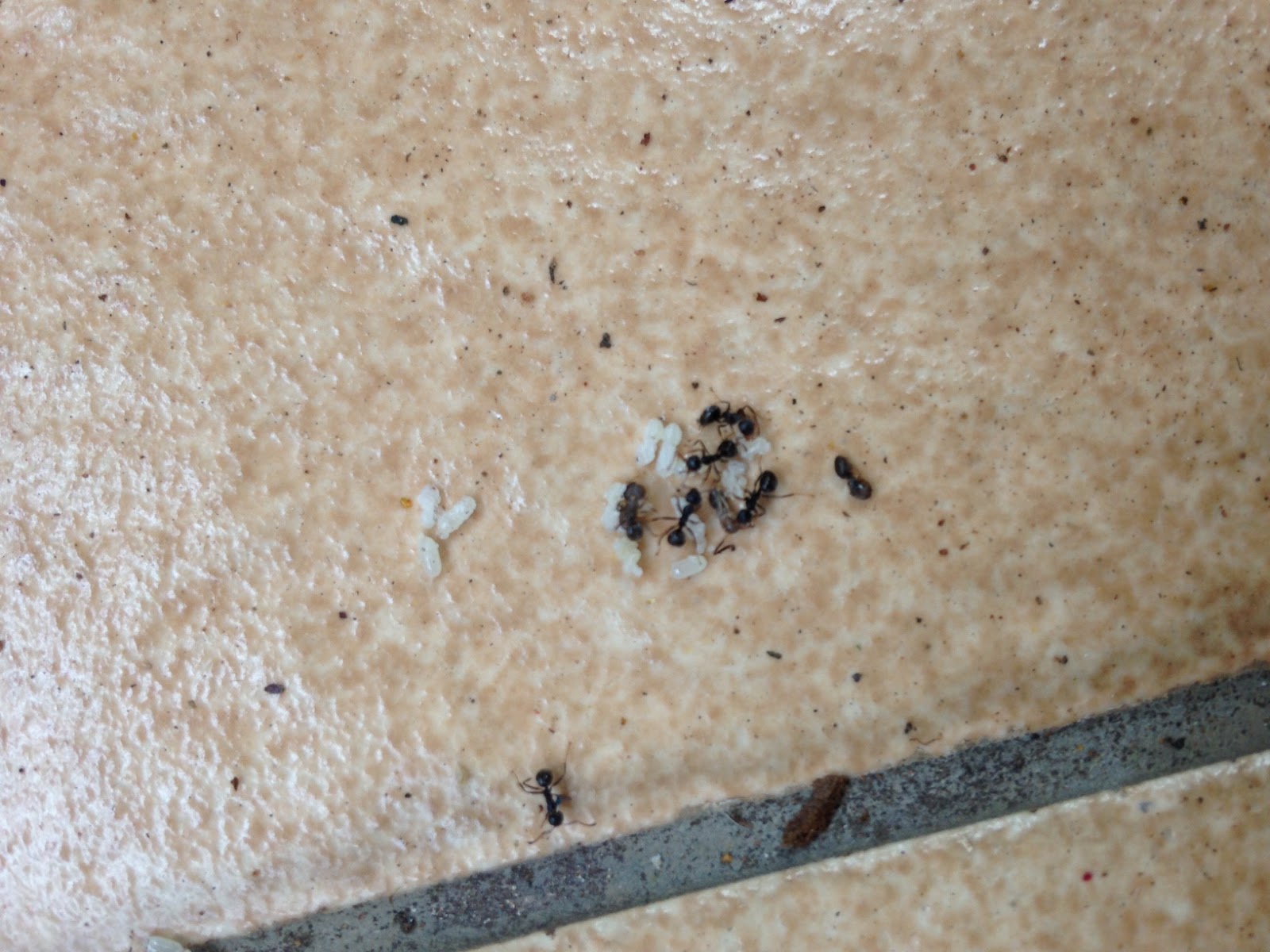
Today my Mom bought a bag of Mangosteen and found a nest of Black Ants on one of the fruit sepals. We shooed away the nannies and kidnapped the eggs and pupae (maybe).  


We saw them under the digital microscope and this is what we saw:

The eggs on the sepal. And perhaps a pupae?

A stuck ant with an egg on its antennae.

Trying to run away.


The crushed dead ants on the sepal.


Sunday, 14 February 2016

Hydrogen

I learned about Hydrogen in my Science chemistry, it's an Alkali Metal too. I'm curious about it because there's an equation which is: metal + water = metal hydroxide + hydrogen. The metal can be one of the Alkali metal. For example, the metal is Sodium, so the equation becomes Sodium + water = Sodium hydroxide + hydrogen.

Hydrogen is here in the Periodic Table:


Hydrogen can be found in the sun, plants and sugar, blowtorches, water, etc. They can be either useful, and dangerous at the same time. 

The uses:

- As our body are mostly made out of water, we need Hydrogen (water/ H2O) to build energy in us.

- Transportation: It can be used as fuel, because it has a quick-burn character.

In the early 1900s, the LZ 129 Hidenburg, a hydrogen-filled passenger airship caught on fire due to the hydrogen, and crashed, killing 35 of the 97 people aboard and one ground crew member. 

http://www.historyinanhour.com/2011/05/06/the-hindenburg-disaster-summary/
That's why we have to be careful in using Hydrogen as fuel.


Tuesday, 2 February 2016

Potassium

I learned about Chemistry in Science several weeks ago. And I read that Potassium fizzes and gives off so much heat, it catches fire.
I want to deepen what I had learned about it. Potassium is an Alkali Metal, and is an Element. They can be found in fireworks, the Crust of the Earth, the oceans, fertilizer, bananas, some other plants and fruit. Pottasium can burst, that's why they're used in making fireworks. All Potassium deposits are found in marine deposits.

Potassium can be used for:

1. Our body: it helps to build proteins, build muscle, and control the electrical activity of the heart.

If we have Potassium deficiency, we could have weak muscles, abnormal heart rhythms, and a slight rise in blood pressure. It's called hypokalemia.

If we have too much Potassium in our body, we could have abnormal heart rhythms, or heart issues.

2. Biology: They are vital to plants in photosynthesis process.  Its essential role is for regulating leaf stomata and controlling water use. For animals, they're mostly used in animal foods. It maintains salt balance between cells and body fluids.

The letter K represents Kalium in the Periodic Table.


Kalium is Potassium in Latin, but to make it easier for English speakers, it's changed to Potassium.

3. Fireworks and smoke bombs are made out mostly of Potassium. Smoke bombs can be used to mark a helicopter's landing, playing, making a dramatic scene/photo, etc.

Wednesday, 16 December 2015

Fire Ant's Baby

Yesterday, when I went to change my tortoise's newspaper sheet in her cage, I found fire ants at the top of a big box next to the cage. They were bringing the babies and were finding for a place to save them. My mother caught one of the ants bringing the baby, and we examined them under our digital microscope. The picture at the left shows it. At first we thought it was an egg, but when we saw it under the microscope, it was clear that it's a baby.


We did a research about fire ants and we found this:

https://6legs2many.wordpress.com/tag/pupae/


I think we caught the queen wannabe. Maybe. What do you 
think?

We also found out that some people made moulds of ant's nests. Such as this one. They ended into these:


http://www.ufunk.net/en/insolite/metal-anthill/


Ants are really great architechts.


Saturday, 29 August 2015

Measuring the Volume of an Irregular Shape Solid Matter Based On the Archimedes Theory

This experiment is based on the Archimedes theory:

Archimedes was a Greek philosopher. One day the King ordered a gold crown from a goldsmith. He wanted to know if the goldsmith had cheated him, so he asked Archimiedes to find out. Archimedes found out the answer  when he went for a bath. The water overflowed when he jumped in. So he dipped the King's crown and a lump of gold with the same weight of the King's crown into the water. He found out that the lump of gold overflowed much more water than the King's crown, so he knew that the goldsmith had cheated the King.
I have a science experiment checking the mass of 4 stones, based on Archimedes's theory.

 These are the materials.
- A cup of water.
- An empty cyllinder.
- 4 different shapes of   stones. (numbered from left to right: 1st, 2nd, 3rd, 4th)


First, I fill the cyllinder with water until 10 ml. The picture at the left is one of the stones that's going to go inside the measuring cylinder.


This is the stone in the cylinder:

And this is the data:

1st stone's volume is 3 ml (when it is dipped the water level becomes 13 ml)

2nd stone's volume is 1ml  (when it is dipped the water level becomes 11 ml).

3rd stone's volume is 3 ml (when it is dipped the water level becomes 13 ml.) 

4th stone's volume is 3 ml (when it is dipped the water level becomes 13 ml)


My conclusion is: we can easily measure an irregular shape solid matter based on the Archimedes Theory by using this method.