Pages

Showing posts with label education. Show all posts

Friday, 7 August 2020

Tante Grey's Infographic Course

Hey guys! I'm extremely sorry for not updating in a really long time. I have been busy studying in the first half of 2020 and I just finished Grade 11 a few months ago. With my main focus on academics, I didn’t find any interesting topics to write for my blog, thus the lack of updates. Now that I am on a short holiday from academics, I have time to join some interesting online events.


One of the online events that I joined was an online infographic design course brought by Tante Greysia Susilo, a design lecturer at Pradita University. I don't know whether she has been planning to open this course for some time or did she open this course because of something that happened in instagram.


There were mean comments from ignorant people about homeschoolers in an IG’s post and comment section. There were a lot of different kinds of negative comments, belittling homeschoolers’ mentality, lifestyle, and social life. What annoyed me was the fact that they were all untrue and it was posted publicly on social media. A lot of people could get the wrong image about us! This made me momentarily thought about arguing with them online with my homeschooler friends. Luckily, I knocked some common sense into myself just in time. The decision to argue was a foolish impulse and it would definitely make things worse.


However, we felt all pent up. My friends and I, were at loss for what to do. We definitely couldn't leave this alone. Luckily for us, we got an advice from Tante Grey that the medicine to ignorance is education. By educating,we not only help them understand, but also channel our negative energy into something positive! 


One of the ways of educating others is through infographics. Thus, Tante Grey offered to teach us to make infographics. Our final project would be making infographics which debunk misconceptions about homeschooler.


The online course took place in zoomland and lasted around 2 months. We met once a week, with a total of 18 homeschool teenage participants. We were taught the basics of making a clear and interesting infographic: from collecting ideas to clustering information. After every meeting, the students were given a task to finish. Those who have finished the task would have their results discussed in the next meeting. There weren't any strict deadlines, but we were expected to finish them at a certain time, otherwise we would be left behind!


First, Tante Grey taught us the basics. There were a lot of simple details that could be easily overlooked when making infographics, such as data placing. We often forget that we should place our data according to how people usually read, which is from left to right and up to down. Instead, we tend to put our data in areas where we think they might look nice. Another thing about infographics is that there shouldn’t be too many words. It should be quick and easy to read.


Then we were given our first task! Tante Grey started by creating a mindmap with “Critiques Homeschoolers receive from the public” as the main theme. The participants were asked to continue it with all the critiques we know. Next,we were asked to pick a specific critique to focus on and make a mind map of the solutions. We were advised to pick the critique that we receive the most, as we would have more to say about it. I picked the topic of socialization.


It took me half of the day to create the mindmap, as I used google drawings in google doc. I’m not familiar with it, so it took me a while to get used to it. In addition to that, I made my mindmap with a lot of pictures. These are proofs that I socialize with a lot of kids my age. As the pictures are scattered in many different electronic files, it also took a long time to find them. I was pretty happy that I advanced to the next step without much critiques.


Once our mindmaps are done, the next task is to cluster or group all the data we made in the mindmap. Sometimes the topic is too broad and we had to narrow it down or choose a specific aspect of it to write about. While clustering, we also had to design our infographic. These two must be done at the same time to decide which data are the most important and choose the appropriate positions to put them on the infographic. I didn’t have any idea of how I should cluster all my data, so Tante Grey lent me a hand. She first asked me to divide my data into several categories, such as my academic and non-academic activities, my variety of activities or the frequency of my socialization. I originally chose to focus on analyzing the latter.


She then gave me examples of how I could divide my frequencies into more categories, such as once a week, once a month, and once a year. She also gave me a format of how my categories would look like in the infographic.


Once I have categorized all my data, all I had to do was put them together. I used Canva, a free programme specifically for graphic design. I experienced some difficulty while making the infographic.


First of all, I rarely make infographics and had little experience in using programmes like Canva. Thus, I had some difficulty getting around. Next, I couldn’t fit all the pictures using my format. Therefore, I decided to change the format. I think I did a pretty good job at it, but Tante Grey said that I had to review my data placement again. I told her my problem with the pictures, which she replied with an infographic of her own XD. She used the same format with the same amount of pictures, thus proving that it’s possible. Following the examples of the placement  of her picture, I finally managed to finish my infographic.


Next we had to ask for feedback. We had to show our infographic to 2 kinds of people: those that are familiar with homeschool and those who aren’t. I chose my parents for the first and my ex-school friends for the second. When asking for feedback, I had to first tell them the message I wanted to send through this infographic. Next, I had to ask if they received the message. Unfortunately, one of the reviewers didn’t get it, but instead she thought I was telling about the variety of activities I did for my socialization.


When I talked about this with Tante Grey, she agreed with my reviewer’s point of view that my infographic seemed to lean towards the variation more. She then showed me an infographic made by one of my coursemates, Vyel. I saw how his infographic leans more to the frequency of socialization with the bar graph he put in his infographic. Seeing the difference I decided to just change my title from “Frequency of socialization” to “Variation of Activities for Socialization”


When most of us had finished our infographics, they are posted in the instagram of my teen group @Teenspower.squad. As the infographics are posted on social media, we hope that more people will be able to understand more about homeschoolers. I think this infographic is also really useful when facing ignorant people --- all we have to do is share these infographics as a reply to their negative comments. As a person who isn't really into graphic design, I found this course overall interesting. When I first started the course, I thought that making an infographic is only about gathering information and designing an aesthetically interesting charts. I never gave thought as what made them enjoyable to read and look at. Through this course, I learned that there is more than just pasting information on a template.


These are the end projects of mine and some others!


Friday, 20 December 2019

A Tale of Discipline

Hello everyone! It's been a long time since I updated about myself, hasn't it?

With all my recent book analysis posts, I hoped that you all didn’t think that my blog has become a book review and analysis blog. It hasn’t. It’s still just a platform for me to share my life-views and activities with you all. I am an avid reader. So I have recently been busy reading and analysing different books, which I found to be quite interesting and educating. But, I get that if you get the same type of posts every few weeks, it would tend to get boring. So I will try to insert other types of writing in between.

To be honest, I only posted my study analyses because I had difficulties in thinking up topics to write in my personal entries. I didn’t participate in too many events recently. I didn't want to add more activities to my schedule, as there's this voice behind my head saying that I still have lots of things to do. During the holidays, I also couldn't hang out with friends because I had to catch up with my studies. I have an allotted study time of seven hours a day. However, I don’t seem to be getting any studying done. What a mystery! I even used to think that one of the reasons I'm unable to get things done was because of my extracurricular activities; and was about to cut them all down. After examining every possible clue, I finally discovered the culprit! D-I-S-T-R-A-C-T-I-O-N-S. Objects of crime: mobile phone, books, pets, daydreams, computer, and Internet access. Perhaps no further explanation is needed. :)

Thinking back, this culprit has been my constant companion for as long as I can remember; ever since my parents decided to trust me to study on my own. This culprit always succeeded in persuading me to trick my parents, and this obviously bore rotten fruits. The academic deadlines I set for myself always seemed to run away from me and I had to constantly chase them. Unfortunately, I acted like a snail and when I finally reached the finished line, I have another or actually many other races to complete. I seemed to be stuck in never-ending races.

In order to persuade myself to change, I had to find motivations. Unexpectedly, I found my motivations in my friends. I have a friend who goes to a prestigious school known for its rigorous and challenging activities. I wanted to experience similar challenges, but as you know, I have many incomplete lessons. Therefore, I felt the urgency to finish my studies so that I can pursue more challenging and exciting activities.

A competitor can also be a great motivator. A few months ago, I joined an academic course, where periodically, there’s an academic assessment. The results would be shown to the whole class. For the first assessment, I ranked 1st in my class. Recently, a new classmate joined the course. He is a diligent and dedicated student. He studied tirelessly, even during break time! I’m very much motivated to maintain my 1st position and he has become a serious challenger. Therefore, I need to work more seriously and harder on my studies.

I discovered that when I have more motivations, I have more drive to make changes, such as studying more and working hard. But motivations can only push me forward; it cannot help me to manage my time. So, I use a study method called Pomodoro Tomato. A pomodoro is to work with full concentration for 25 minutes then break for 5 minutes. Every 3rd pomodoro, I break for a longer time; usually for 15 minutes.

With these to help me catch up my studies, I'm starting to get back on track. I managed to find time to explore my coordinating skills. I became the coordinator of a homeschool event. Coordinating the event is quite time consuming as I need to spend a lot of time managing people. Therefore, I’m still hesitant in trying a new hobby, as it also takes up time to practise the skills. I still have subjects to catch up with, even though they're not as many as my previous years. I hope that these methods will help me for a long time. I’m very sure that at some point in my life in the future, I will be distracted again. Hopefully, I will find new motivations to help me get back on track!

Thursday, 22 November 2018

Homeschooling: An Alternative for Education

Recently, homeschooling has become a popular choice among families who are not comfortable with the limitations of formal schooling, my family included. Some people confuse homeschool with flexi school or tutoring. Homeschooling is learning on our own in our home. As for Flexi schools, students study at home but still go to classes organized by the educational organization two to three days a week. Whereas tutoring is having someone come and teach you at your home.

There are also many different home schooling methods. Some followed a method made by Charlotte Mason and there are those who pay for a program where they can get printable modules. Some others, like me, designed our own lessons. There are various more types of homeschooling, but those 3 methods above are the ones that I’m most familiar with. I studied in a formal school up to primary level. Afterwards, I began homeschooling for junior high level. Homeschooling is much more flexible in many aspects, including time management, subjects we learn, teaching methods, etc. Although homeschooling is far from perfect, I think its benefits outweigh its limitations.

I experienced quiet a staggering amount of school tasks when I was in primary school and up till now, I still get plenty of complaints from my former primary classmates about their pile of works. They had to follow the government’s curriculum, which includes a lot of subjects. Students have to study math, science, Bahasa Indonesia, religion, PKN, etc. After school, they still have academic courses (bimbel) to catch up with their school subjects. Additionally, they also must complete tons of projects and study for exams. That leaves no time for them to pursue subjects that they are interested in.

With homeschooling, I had a more flexible schedule compared to my school friends. I only studied the necessary subjects that I need for my life and things that interests me. I study basic lessons such as math to calculate well, science to understand how everything works, language so I can communicate correctly with others, geography and history so I know about the world I live in. I also play music for fun. My average schedule everyday consists of several hours of math, science, and geography. Additionally, I also study English, history, and music as subjects that I have great interest in.

In most schools, students are usually taught in a uniform style. Students’ uniqueness and abilities are not taken into consideration. All students have their own learning styles and talents. Teachers expect students to learn what they teach in the same way and the same pace. This will result in that some students will fail in some subjects because they are not good at it. They will be given extra lessons and pressured to improve their grade. On the other hand, the subjects that the students excelled at will be overlooked because their grade is already good enough to pass. This situation will make the students feel frustrated because they are only drilled to focus to improve their weaknesses. Yes, weaknesses should not be ignored, but it’s the students’ capabilities that should be developed. This will make them excel in what they’re good at; they will not become a “Jack of all trades”. It’s a figure of speech used to call people who are able to do everything, both their weaknesses and strengths, but they are a master of none.

School teaching methods are also usually teacher-centered. Teachers control the subject materials and study pace. They “spoon fed” the lessons to the students; the teacher explain and the students are expected to pay attention. Afterwards, they will be given exercises to do and they will be expected to complete the exercises according to what the teachers have taught. Students are usually not allowed to have different answers or working methods to the exercises.

Meanwhile homeschool is student centered. This means that the children have control (with parent supervision) over their study pace. They have to make their own study schedules and learn the lessons on their own. They are not required to finish learning the lesson within a certain time frame (one hour for example), but the goal is to master and understand the lesson, however long it takes.

A lot of people are still confused about how homeschoolers learn. Well, I just open my textbook and read! I then try to understand the chapters and do the written and practical exercises from the books. When I have trouble understanding my lessons, I proactively find and use other resources to help me. Some of my sources are my parents (they are not teachers), the internet, and books. We have to read and understand the lessons on our own, without a teacher to explain directly to us. We will be more independent problem solvers because we do not depend on just our teachers to help us, but we learn to find different methods to learn until we understand the lessons.

I learned to discipline myself through homeschooling. When I was at school, I did my school tasks mostly out of fear of my teacher. It’s not that my teachers are fierce, it’s just that they are capable of threatening us and are able to give out punishments. Until now, I still have problems with disciplining myself. Back home, there was no one to do those, so I sometimes still wait for my mom’s presence and reminders to study. My parents didn’t threaten and punish me because they want me to be able to control and discipline myself. I often hear comments about how homeschool students lack socialization. This is an ignorant comment. As much as I’d like to be respectful here and not judge other people’s questions, I really find that question annoying. It’s as if because I am a homeschool student, I’m scared of other people and I don’t socialize at all. Homeschool students have more flexibility in socializing than school students. We learn to socialize in different kind of situations and with people of all ages, not limited to just students our age.

I have learned to make friends with different type of people through my every day activities. I have friends from my homeschool club, workshops that I joined, courses, and events. I also get the chance to meet and talk with my neighbours when I am walking my 3 dogs. They range from as young as 6-7 years old to middle aged adults. I learned different ways to talk with different kinds of people. I’d like to tell you of one of my group of friends. Behind my neighbourhood there is a slum and they often roam around my neighbourhood. Most of them are afraid of dogs and would run off if they see them. Now one morning I was walking my dogs and a group of slum girls took interest in my dogs. They watched from afar and took photos of them, but they still didn’t dare come near us. I told them that my dogs are not fierce and won’t bite and encouraged the girls to pat them if they want to, which they did. They had fun interacting with my dogs and became attached to them. The girls and I also became friends. School students usually have a more limited socialization environment. They usually make friends with classmates their age just because they spend nearly the whole week with them in their classrooms. Aside from that, they might make friends while they attend tuitions outside of school. School children also often suffer from peer pressure, where we have to change ourselves to be accepted by others. A lot of these students don’t know how to interact with people outside of this zone. From my personal experience, usually homeschoolers are more open to people compared to school kids. When I first met my other homeschooler friends, I could feel that they were much more open and friendly. When I participated in homeschool events, the homeschoolers are usually quite happy to meet new friends. In comparison, when I had gymnastics class comprised of all school students, I discovered that the students there have groups, exclusively made out of their own don’t often mingle with students outside their group.

In my country, there is a mandatory national exam to be taken at the end of our primary level, junior high, and senior high. To be able to join the exam, I joined a government institution called a PKBM to have my student number registered. They will take care of student administrations for the exam to the government, and all I have to do are sign some papers. PKBM is a place where homeschoolers who have no resources to learn from can meet up to discuss about their lessons. There are mentors there too to help us out.

Homeschooling is not for everyone. However, for families who think that formal schooling gives negative impacts to their children, homeschooling can be considered as an alternative. There are many ways to learning and receiving education. We can choose the methods that suit us the best. The most important thing though, is that we learn and are happy.

Learning anywhere anytime.

Have you ever seen this funny video about homeschooling? Check it out here!


Monday, 29 May 2017

My First Time Baking (Almost All) By Myself

I went to the Big Bad Wolf book sale and bought several books. It's not as much as the last one, because I came there on the last day and only try to find the "gem among the dirt". One of the books I bought was "Baking". At that time it was past lunchtime and I passed the food category, so I stopped by and saw that book, so I felt that I really have to buy that book. I promised one of my friends that I'll bake something and bring it to her, so I baked these cookies yesterday morning.

They are originally called "Jumbo Chocolate Fudge Cookies" by the book, but I renamed them as "Cashew Choco Cookies", as I changed the white chocolate into cashew nuts. 

This is their original recipe:


I baked half of the ingredients first so that if I fail, I won't waste that much. From that half amount of the recipe, I still reduced the amount of the chocolate and sugar so that it won't be too sweet, 

My mom helped me with the preparations. It took almost 2 hours, and baking took almost half of the day :D. 

Hopefully my friend like it!


Sunday, 27 November 2016

My Latest Coursera Accomplishments.

So far I have accomplished 2 Coursera courses, and even though I already forgotten most of what I have learnt, I am proud of it :D

The first one is "Arch Of titus: Rome and the Menorah" from Yeshiva University. I often failed the last assignment of this course, that's why I have been participating in this course for over 6 months or even more....., and finally I got my grade:


The second one is Ancient Egypt and Its Civilization. This one is a recent one:


I can finish this so fast :p. I finished it 2 weeks before the deadline. I think it's because I learned a lot about Ancient Egypt when I was younger, the new ones are the only hard ones for me. 

I really love both of these courses, and I hope the informations that I received could be used for future uses!


Wednesday, 21 September 2016

Flour Beetles in My Turtle's Food

I usually feed my turtles by taking a half-handful amount in my hand and sprinkling it out to them, but at this time, I saw that there were wiggly things in the water. When I checked the turtle's food bottle, I discovered flour beetle insects and larvaes. (Since then I used a spoon to feed my turtles.)

Here is a short summary of them:

Flour beetles (Tribolium confusum and T. castaneum) are 3/16 inch long, reddish-brown, and elongate oval in shape. Larvae are cylindrical, whitish, or cream-colored and up to 1/4 inch long and have two small pointed spines on the tail end (the larvae are not usually noticed by residents). Two species of flour beetles may be found: red flour beetles are common in homes and the confused flour beetle is a frequent pest in flour mills. Flour beetles infest many types of dried food products, such as flour, bran, cereal products, dried fruits, nuts, and chocolate. (I get it from here).
Here are the pictures:
The larvaes in my turtle's food.
The larvae is on the left, the adult one on the right. They both were compared to an average key size.

We suspect that this was either part of
the nest or a cocoon.

Ants taking the larvaes.

Only, the ants had difficulty doing it,
as the larvaes attack back, and the ants often failed.

Tuesday, 16 August 2016

My Recent Coursera Accomplishments

I completed several courses on history and one in paleontology. Their deadlines were so close together, I had to rush to finish them!

 This is my accomplishment for the course The Holocaust-An Introduction (I): Nazi Germany: Ideology, The Jews and the World.

My accomplishment for the course The Holocaust-An Introduction (II): The Final Solution.

I'm now really interested with modern history, especially WW2, so, as this course explores the details into it, I find this really interesting.

My accomplishment from Paleontology: Early Vertebrate Evolution

I've always loved paleontology since I was young, so I found this course interesting too! Only the biology level is much harder than my ability. I reviewed the lessons and combed Wikipedia and Google to solve this hard biology :D. 


Sunday, 5 June 2016

My 8th and 9th Certificate From Coursera

These are my 8th and 9th certificates from MOOC courses. The courses are "Code Yourself! An Introduction to Programming" and "Introduction to Philosophy".


Although for the Code Yourself course, my father said that 40% goes to him, because he assisted me a lot. :p

I highly recommend these courses for anyone who thinks greatly, complicatingly and heavily.

Friday, 6 May 2016

Mummies

I recently read this book about Mummies (which has been in my book shelf for ages :D). Not only the Egyptian ones, but about many types of mummies, like the "accidently" made mummies, the Incan mummies, and the "not-meant-to-be" mummies. I'll tell you about them later. This book has been on my


You know the Egyptian mummies, it's from their religion.

The "accidently" made mummies are the people who died in very cold places, such as Antartica and the Artic. They died possibly of lead, which was found on the seal of the food tin cans they brought, causing them to be unable to think or unable to move. Such as this:

That is John Harnell, an explorer who froze to death in the Arctic.

The "not-meant-to-be" mummies are the deceased people who were buried in caves by their relatives, who didn't mean to make them into mummies. They became mummies due to the very cold or very dry climate which stops bacteria from growing on it and rotting it (bacterias need air and water to grow) by either drying the body up or making an air tight space. 

But some deceased people were filled, injected, etc, with chemicals which makes their bodies look real and "alive". One such famous mummy is Rosalia Lombardo, who died at age 2 more than 96 years ago, but still looked like as if she's taking a nap. Her father was so heartbroken over her death until he asked a doctor named Alfredo Salafia to mummify her (in this case make her body look real). We don't know how is the procedure of "chemicaling" her, as Mr. Alfredo no longer lives today.
She's often nicknamed "the sleeping beauty"
https://thechirurgeonsapprentice.com/2014/04/18/deaths-doll-the-worlds-most-beautiful-mummy/


Sunday, 1 May 2016

The Big Bad Wolf Bookfair

Last Saturday I went to a bookfair called Big Bad Wolf. It's held in ICE, BSD, and is open everyday starting from April 30th - May 8th. Here's the schedule:


The books there are really cheap! The cheapest book that I saw costs Rp.10000. These are the books that I bought:


I also bought World War II books, as I'm interested in them currently:


And this is a sneak peak to the book "D-Day Remembered". They're really interesting and inviting:

They have some copies of the real documents (letters, passports, etc.) 

In total, these are the books that I bought:


I think it is a worthy place to go to. If they held it in Indonesia again, I'd surely go there! Hopefully next time they will come with more books from my list. 


Sunday, 14 February 2016

Hydrogen

I learned about Hydrogen in my Science chemistry, it's an Alkali Metal too. I'm curious about it because there's an equation which is: metal + water = metal hydroxide + hydrogen. The metal can be one of the Alkali metal. For example, the metal is Sodium, so the equation becomes Sodium + water = Sodium hydroxide + hydrogen.

Hydrogen is here in the Periodic Table:


Hydrogen can be found in the sun, plants and sugar, blowtorches, water, etc. They can be either useful, and dangerous at the same time. 

The uses:

- As our body are mostly made out of water, we need Hydrogen (water/ H2O) to build energy in us.

- Transportation: It can be used as fuel, because it has a quick-burn character.

In the early 1900s, the LZ 129 Hidenburg, a hydrogen-filled passenger airship caught on fire due to the hydrogen, and crashed, killing 35 of the 97 people aboard and one ground crew member. 

http://www.historyinanhour.com/2011/05/06/the-hindenburg-disaster-summary/
That's why we have to be careful in using Hydrogen as fuel.


Tuesday, 2 February 2016

Potassium

I learned about Chemistry in Science several weeks ago. And I read that Potassium fizzes and gives off so much heat, it catches fire.
I want to deepen what I had learned about it. Potassium is an Alkali Metal, and is an Element. They can be found in fireworks, the Crust of the Earth, the oceans, fertilizer, bananas, some other plants and fruit. Pottasium can burst, that's why they're used in making fireworks. All Potassium deposits are found in marine deposits.

Potassium can be used for:

1. Our body: it helps to build proteins, build muscle, and control the electrical activity of the heart.

If we have Potassium deficiency, we could have weak muscles, abnormal heart rhythms, and a slight rise in blood pressure. It's called hypokalemia.

If we have too much Potassium in our body, we could have abnormal heart rhythms, or heart issues.

2. Biology: They are vital to plants in photosynthesis process.  Its essential role is for regulating leaf stomata and controlling water use. For animals, they're mostly used in animal foods. It maintains salt balance between cells and body fluids.

The letter K represents Kalium in the Periodic Table.


Kalium is Potassium in Latin, but to make it easier for English speakers, it's changed to Potassium.

3. Fireworks and smoke bombs are made out mostly of Potassium. Smoke bombs can be used to mark a helicopter's landing, playing, making a dramatic scene/photo, etc.

Sunday, 31 January 2016

Masterclass With Ms. Pinkcheer S. Tamio

Last Monday I had a masterclass with Ms. Pinkcheer in Gloriamus Music School. It was really great! She has a PHD of Musical Arts in Piano Performance from West Virginia University. This is my picture with her:


Tomorrow I will start my piano class with her. She will be my piano teacher besides Ms. Julina Jaya.

Saturday, 2 January 2016

My First edX certificate

edX is an online course, a MOOC, just like Coursera. I previously joined some edX courses, but I forgot them with my busy school schedule and eventually the deadlines had passed. This is my first course which I passed after I am homeschooled, called "A Christmas Carol" by Charles Dickens. Taught by Ms. Maggie Sokolik who made something like a book club there, which discuss many types of Classical books (famous stories which were written a pretty long time ago and had been retold again, such as Dracula, Frankenstein, and the Adventures of Huckleberry Finn). Each book is discussed once in a month, and this last December, we discussed about "A Christmas Carol".  Here is my certificate:

My mom screenshoted it, as my printer ran out of ink. The course was really fun. There were many to discuss about, and I found some points which I missed whithout really paying attention. It was a great course, willing to take another one from this!

Wednesday, 16 December 2015

Fire Ant's Baby

Yesterday, when I went to change my tortoise's newspaper sheet in her cage, I found fire ants at the top of a big box next to the cage. They were bringing the babies and were finding for a place to save them. My mother caught one of the ants bringing the baby, and we examined them under our digital microscope. The picture at the left shows it. At first we thought it was an egg, but when we saw it under the microscope, it was clear that it's a baby.


We did a research about fire ants and we found this:

https://6legs2many.wordpress.com/tag/pupae/


I think we caught the queen wannabe. Maybe. What do you 
think?

We also found out that some people made moulds of ant's nests. Such as this one. They ended into these:


http://www.ufunk.net/en/insolite/metal-anthill/


Ants are really great architechts.


Monday, 30 November 2015

Parthenon Part 4: The Later History of the Parthenon (Last Part)

After the middle or third century AD, a fire broke out in the Parthenon, destroying the roof and much of the interior. Some pirates also sacked Athens, destroying the buildings, including the Parthenon. Repairs were made in the fourth century AD, but they did it incorrectly.

One day in 435 AD a king named Theodosius II decreed that all pagan temples from the Byzantine Period be closed and that includes the Parthenon. Somewhere between the 5th century, the Athena statue (read Parthenon Part 1) was stolen and brought somewhere, where it was destroyed.

It was then changed into a Christian Church. The shape of the church was changed to face the east, the main door facing the West.

Next, it was changed into a mosque when the Ottoman Turks arrived. Although the Parthenon had been changed into a church and then a mosque, the basic shape and structure is still intact. Here's a picture of the Parthenon as a mosque:

https://en.wikipedia.org/wiki/Parthenon

 The Parthenon was then destructed enourmously when the Venetians led by Francescoe Morosini, attacked Athens and captured the Acropolis. A Venetian mortar round fired and blew up part of the Parthenon. It caused large fires that burned an amount of buildings.

But now the Parthenon is being restored really carefully. The scientists are pretty confused of how to make it exactly like how the Ancient Greeks did. Now it is still in the process.

Tuesday, 13 October 2015

The Parthenon Part 3: The Collumns of the Parthenon

Here I'm going to tell you about the collumns of the Parthenon. The collumns are in the Doric Order. Below is a doric order collumn:

First let me tell you about the orders. They're quite complicated to explain. In total, there are 5 types of column orders: Doric Order, Ionic Order, Corinthian Order, Tuscan Order and Composite Order. The Doric, Ionic, and Corinthian, are from the Greeks, while the Tuscan and Composite are from the Romans. They're all classical orders.The doric order is the oldest order, and the simplest one.

We'll talk starting from the top fo the collumn. The triglyph comes from the word tri, which means "three", and glyph, which means mark, so triglyph means three marks. You can see three lines there up in the picture.

The space between the triglyphs are called metopes, which are often filled with sculptures.

The abacus, or the slab at the top of the collumn is just simple.
https://www.pinterest.com/pin/145381894195548785/
Now we go to the tricky part. Most people think that the collumns are straight, but actually they're not. From the top towards the middle, the width grows bigger, then towards the bottom, it tapers, which means the width becomes smaller.  So the widest point is at the middle, and the thinnest point is at the top. The collumn is not carved out of one stone, they're carved from different stones. They put them together by making a hole at the centre of the already-carved stones, so that a piece of wood will string them together. 

It's quite fascinating because the Ancient Greeks made the shaft have a sense of elasticity, making it able to bear the weight above it, and design it not only using math and geometry, but also with human perception, because the further we go, the smaller something is. 

This is the end of Parthenon Part 3


Tuesday, 8 September 2015

The Story of Prometheus

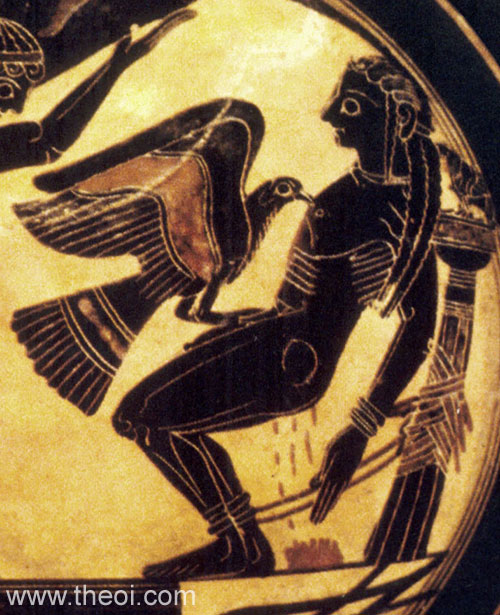
The good titan, Prometheus, that I had mentioned before in the Coming of the Greek Gods, was asked by Zeus to create man out of clay, and teach them how to live on earth, the basics of life, and the gifts of everything. But he might not give them the gift of fire, for that belonged to the gods. Without fire, teaching mankind and mankind's life became hard and slow work. If he gave fire to mankind, he would surely be punished by Zeus. But he had to give them, to make the job faster. So before he gave fire to mankind, he asked his good brother titan Epimetheus, to take care of them when he was punished by Zeus. Finally Prometheus gave fire to mankind and was punished by Zeus.

Zeus punished Prometheus by chaining him onto a rock and everyday an eagle would come and ate his liver. But then it would grow again and the next day the eagle would eat it again. Repital. But Prometheus told Zeus that the giants would one day overthrow him, and only he (Prometheus) knew the solution. Only he won't tell until he was realeased. Zeus had no intention realeasening Prometheus, so Prometheus didn't tell Zeus. (He would be released in another Greek myth)

http://www.theoi.com/Titan/TitanPrometheus.html

Tuesday, 1 September 2015

How Smart Hermes Was.

Hermes was the son of Zeus and a mortal woman named Maia. He was the gods' messenger, and also sent the dead souls to the underworld. This is the statue of Hermes:
Hermes Ingenui Pio-Clementino Inv544.jpg
https://en.wikipedia.org/wiki/Hermes


This is a famous myth about how smart Hermes was:

When Hermes was a little boy, a toddler age, he went to steal Apollo's 50 cows for fun. Apollo was a god, but a sheperd too.  He threw away his own sandals and made another, with the straps on the place where the heels should be. So when he walked, his tracks were showing backwards. He also brought and pulled the cows backwards, so that Apollo would not recognize the tracks and go the wrong way. He passed an old man and gave him several cows, telling him not to tell anyone if he passed. But he didn't trust the old man so a little time later, he dressed as a traveller and asked the old man if a little kid went this way. The old man told the truth, and so Hermes with rage changed the man into stone. Then he brought the cattle towards where he lived: a cave. Soon it became night and Hermes killed 2 cows, and divided it as an offering to the 12 gods, (except Apollo, of course, so the twelfth is for him), then continued on his way towards the cave. He hid the cows there. 

When Apollo found out that his cattle had been stolen, he tried to track it but wasn't able to. When he found out that it was Hermes who stole it, he went to the cave and found Hermes there. Hermes just looked at him with an innocent face, and when Apollo accused him for stealing the cattle, Hermes just said that he (Hermes) was still a toddler, how could he steal 50 cows all on his own? After argueing, Apollo brought Hermes to Zeus. Zeus was ammused by Hermes's theft, but asked him to confess his mistake. So finally Hermes confessed his mistake and showed Apollo what he just did. Then he played the lyre that he just made and learned how to play, and Apollo really wanted that lyre. So he traded his cattle wih Hermes for the lyre, and also gave him the Herald's Golden Staff, which was one of his symbols now. The other one was the winged sandals that Zeus gave him for he was the gods' messenger. Afther this exchange Apollo became the god of music, and Hermes became a shepperd, like Apollo's job before. 

https://xsmyth2012.wikispaces.com/Hermes
                       That's the end of the famous myth of Hermes.

Saturday, 29 August 2015

Measuring the Volume of an Irregular Shape Solid Matter Based On the Archimedes Theory

This experiment is based on the Archimedes theory:

Archimedes was a Greek philosopher. One day the King ordered a gold crown from a goldsmith. He wanted to know if the goldsmith had cheated him, so he asked Archimiedes to find out. Archimedes found out the answer  when he went for a bath. The water overflowed when he jumped in. So he dipped the King's crown and a lump of gold with the same weight of the King's crown into the water. He found out that the lump of gold overflowed much more water than the King's crown, so he knew that the goldsmith had cheated the King.

I have a science experiment checking the mass of 4 stones, based on Archimedes's theory.

 These are the materials.
- A cup of water.
- An empty cyllinder.
- 4 different shapes of   stones. (numbered from left to right: 1st, 2nd, 3rd, 4th)


First, I fill the cyllinder with water until 10 ml. The picture at the left is one of the stones that's going to go inside the measuring cylinder.


This is the stone in the cylinder:

And this is the data:

1st stone's volume is 3 ml (when it is dipped the water level becomes 13 ml)

2nd stone's volume is 1ml  (when it is dipped the water level becomes 11 ml).

3rd stone's volume is 3 ml (when it is dipped the water level becomes 13 ml.) 

4th stone's volume is 3 ml (when it is dipped the water level becomes 13 ml)


My conclusion is: we can easily measure an irregular shape solid matter based on the Archimedes Theory by using this method.