Pages

Monday, 21 September 2015

An Elegant Evening in Batavia Marina

I was invited to my granduncle AB. Susanto's 65th birthday party and book launching of his new book "Potrait of an Ordinary Person Loved By God." It was  held in Batavia Marina, Ancol, where the building is right next to a harbour for goods. First we had a mass, and I played the opening song "Kasih Dari Surga" on the grand piano. Below is the picture of the mass. 


And this is the board at the front of the party showing the book he's launching.

After the mass, I played several songs that I had prepared for this day while the guests explored around and chat with their friends. The violinist joined me.

The violinist had to go, so I played alone.


This is the party outside with a "Sunda Kelapa"cruise as a background.

This is me with the boats out there.
 And this is the gamelan at the entrance. After playing the piano I and my father went around and took pictures.
This is the stairs at the entrance.


Tuesday, 8 September 2015

The Story of Prometheus

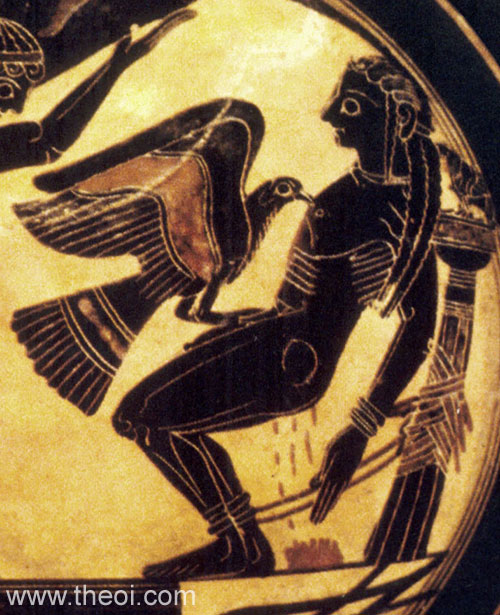
The good titan, Prometheus, that I had mentioned before in the Coming of the Greek Gods, was asked by Zeus to create man out of clay, and teach them how to live on earth, the basics of life, and the gifts of everything. But he might not give them the gift of fire, for that belonged to the gods. Without fire, teaching mankind and mankind's life became hard and slow work. If he gave fire to mankind, he would surely be punished by Zeus. But he had to give them, to make the job faster. So before he gave fire to mankind, he asked his good brother titan Epimetheus, to take care of them when he was punished by Zeus. Finally Prometheus gave fire to mankind and was punished by Zeus.

Zeus punished Prometheus by chaining him onto a rock and everyday an eagle would come and ate his liver. But then it would grow again and the next day the eagle would eat it again. Repital. But Prometheus told Zeus that the giants would one day overthrow him, and only he (Prometheus) knew the solution. Only he won't tell until he was realeased. Zeus had no intention realeasening Prometheus, so Prometheus didn't tell Zeus. (He would be released in another Greek myth)

http://www.theoi.com/Titan/TitanPrometheus.html

Tuesday, 1 September 2015

How Smart Hermes Was.

Hermes was the son of Zeus and a mortal woman named Maia. He was the gods' messenger, and also sent the dead souls to the underworld. This is the statue of Hermes:
Hermes Ingenui Pio-Clementino Inv544.jpg
https://en.wikipedia.org/wiki/Hermes


This is a famous myth about how smart Hermes was:

When Hermes was a little boy, a toddler age, he went to steal Apollo's 50 cows for fun. Apollo was a god, but a sheperd too.  He threw away his own sandals and made another, with the straps on the place where the heels should be. So when he walked, his tracks were showing backwards. He also brought and pulled the cows backwards, so that Apollo would not recognize the tracks and go the wrong way. He passed an old man and gave him several cows, telling him not to tell anyone if he passed. But he didn't trust the old man so a little time later, he dressed as a traveller and asked the old man if a little kid went this way. The old man told the truth, and so Hermes with rage changed the man into stone. Then he brought the cattle towards where he lived: a cave. Soon it became night and Hermes killed 2 cows, and divided it as an offering to the 12 gods, (except Apollo, of course, so the twelfth is for him), then continued on his way towards the cave. He hid the cows there. 

When Apollo found out that his cattle had been stolen, he tried to track it but wasn't able to. When he found out that it was Hermes who stole it, he went to the cave and found Hermes there. Hermes just looked at him with an innocent face, and when Apollo accused him for stealing the cattle, Hermes just said that he (Hermes) was still a toddler, how could he steal 50 cows all on his own? After argueing, Apollo brought Hermes to Zeus. Zeus was ammused by Hermes's theft, but asked him to confess his mistake. So finally Hermes confessed his mistake and showed Apollo what he just did. Then he played the lyre that he just made and learned how to play, and Apollo really wanted that lyre. So he traded his cattle wih Hermes for the lyre, and also gave him the Herald's Golden Staff, which was one of his symbols now. The other one was the winged sandals that Zeus gave him for he was the gods' messenger. Afther this exchange Apollo became the god of music, and Hermes became a shepperd, like Apollo's job before. 

https://xsmyth2012.wikispaces.com/Hermes
                       That's the end of the famous myth of Hermes.

Saturday, 29 August 2015

Measuring the Volume of an Irregular Shape Solid Matter Based On the Archimedes Theory

This experiment is based on the Archimedes theory:

Archimedes was a Greek philosopher. One day the King ordered a gold crown from a goldsmith. He wanted to know if the goldsmith had cheated him, so he asked Archimiedes to find out. Archimedes found out the answer  when he went for a bath. The water overflowed when he jumped in. So he dipped the King's crown and a lump of gold with the same weight of the King's crown into the water. He found out that the lump of gold overflowed much more water than the King's crown, so he knew that the goldsmith had cheated the King.

I have a science experiment checking the mass of 4 stones, based on Archimedes's theory.

 These are the materials.
- A cup of water.
- An empty cyllinder.
- 4 different shapes of   stones. (numbered from left to right: 1st, 2nd, 3rd, 4th)


First, I fill the cyllinder with water until 10 ml. The picture at the left is one of the stones that's going to go inside the measuring cylinder.


This is the stone in the cylinder:

And this is the data:

1st stone's volume is 3 ml (when it is dipped the water level becomes 13 ml)

2nd stone's volume is 1ml  (when it is dipped the water level becomes 11 ml).

3rd stone's volume is 3 ml (when it is dipped the water level becomes 13 ml.) 

4th stone's volume is 3 ml (when it is dipped the water level becomes 13 ml)


My conclusion is: we can easily measure an irregular shape solid matter based on the Archimedes Theory by using this method.

Tuesday, 25 August 2015

Parthenon Part 2: The Parthenon Frieze, and the Parthenon In Colour.

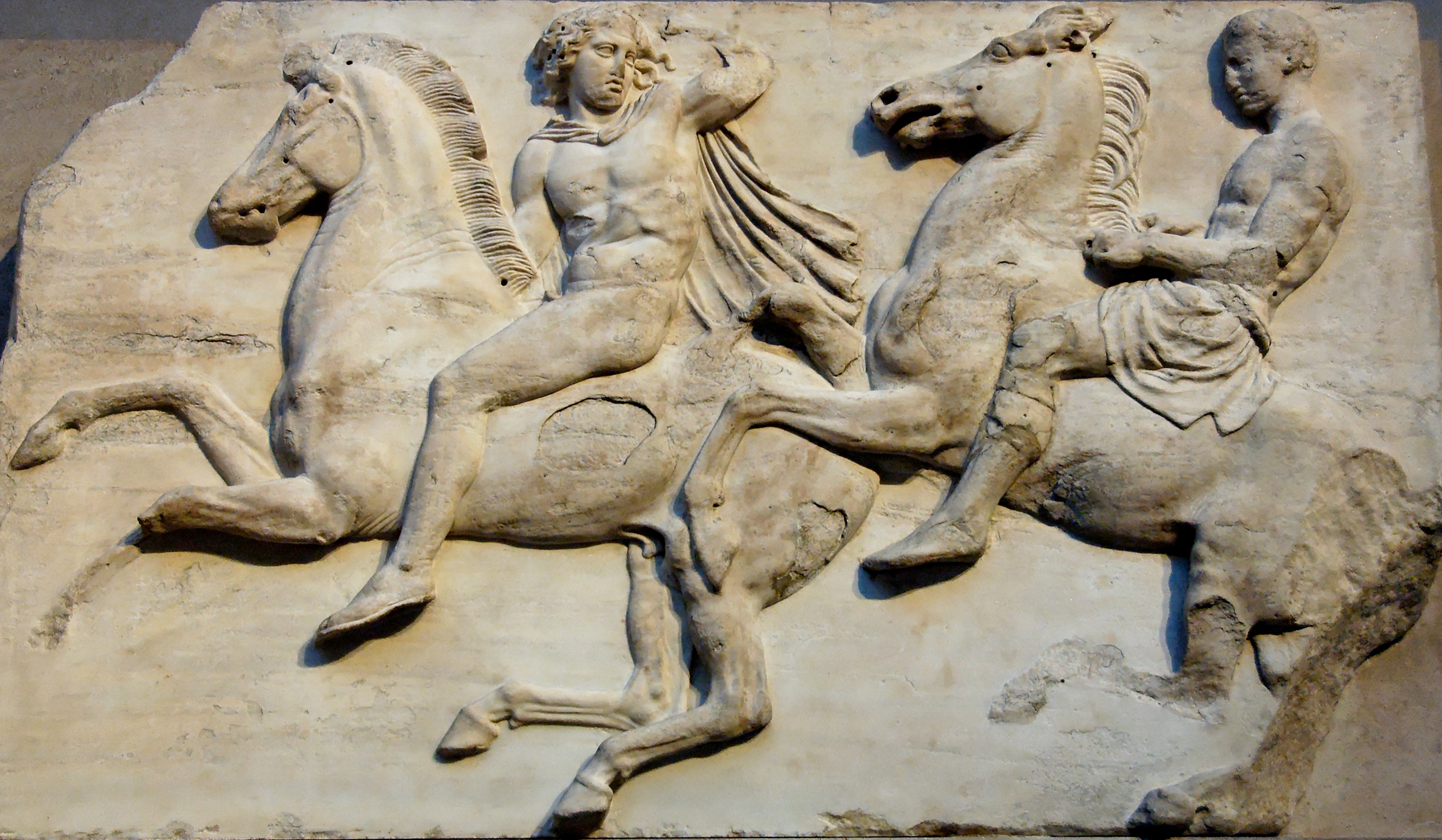
I have written about Parthenon Part 1, and now it's Parthenon Part 2! Here I'm going to write about the friezes, made out of marbles in the temple, which lined up on the walls, and also the marble sculptures in the Parthenon. Friezes are carved stone walls, like this:

https://en.wikipedia.org/wiki/Parthenon_Frieze
The friezes stories were taken from myths, mythical battles, and stories of heroes. The one in the left is a picture of a battle leader on horse waving his hand to say stop to his assistant. They walled up the walls in the Parthenon. 
http://www.athensguide.org/the-elgin-marbles-of-pathenon.html
                        
There are sculptures in the Parthenon too. These are the marble statues in the British Museum, taken from the Parthenon.  

 Now we're going to discuss about the Parthenon In Colour. Usually you see the sculptures and friezes, and temples from Ancient Greece greyish-white. But actually they had colours. They might look strange and much better without colour, because we're used to it. Here's how they look like with colour:

http://linneawest.com/tag/painted-replica
This is how the Parthenon looks like with colour.
And this is how a statue of an archer in colour looks like. Looks strange right? This picture was taken from:
http://www.smithsonianmag.com/arts-culture/true-colors-17888/

This is how Aphrodite, the goddess of beauty and love looks like in colours:

http://www.smithsonianmag.com/arts-culture/bringing-the-color-back-to-ancient-greece-80032254/

The scientists found out that the statues' colours by using an imaging technology called photo-induced luminescence to find the specks of pigment. Also by using infra-red light on it, it showed Egyptian blue colour, which is often found on the statues, such as on the belt of Poseidon's messenger Iris, and on the cloak of goddess Dione. 

http://www.dailymail.co.uk/travel/article-2676413/Athenss-Acropolis-Museum-celebrates-fifth-anniversary-digital-programme-colour-Parthenon-Marbles.html
                              This is one of the frieze in colour.

As time passes, the colours from the statues, buildings, and friezes faded away. These are some reasons why the Parthenon's colours faded away: because of war, changed into a church and mosque, and destroyed. That is also why you see the Parthenon in ruins now.

To be continued.

Sunday, 16 August 2015

The Coming of the Greek Gods


http://www.talesbeyondbelief.com/greek-gods/zeus.htm

I wrote the beginning of Egypt's gods, godesses, and Egypt's myth here. Now, I'm going to tell you about the myth of the beginning of Greek's gods and godesses. The story was told before writing was made, so it was passed down orally, and sometimes the story got mixed up. Greece has many places, such as Athens, Sparta, and Olympia (that's well known for the place where the gods dwell), and if people from those places meet together and retell the story, all of them will be confused. Some people will say "Leto is Zeus's wife", while some say "No! Hera is Zeus's wife." In the ancient times, man used to have many wives, with the first as the chief wife, so finally it was concluded that Zeus had many wives, and it was known that Hera was the chief wife.

Let's Start.
First, there was chaos all around. Then night and Erebus (darkness) were born, where death dwells. From them, love was born, Love created light and day. The first creatures born from it were Gaia (mother Earth) and Uranus (father Heaven). They had children who were the Hechatocheires ( monsters with fifty heads) , Cyclopses, and Titans. There were many Titans, and one of the Titans was Kronos. Kronos looked really gigantic (as how Titans did) and had a sickle, and with that sickle he wounded his father Uranus. From Uranus's blood that spilt into the land, there formed the giants and also his blood that spilt into the sea formed Aphrodite. Below was Kronos wounding Uranus.
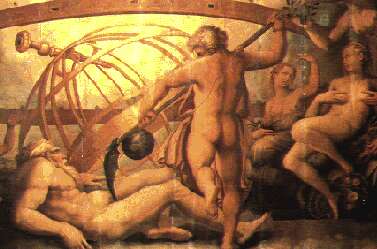
http://www.the-dreamweaver.net/portal/en/articles/2-uncategorised/41-the-cycles-of-saturn-and-uranus
After that, Kronos ruled the world and married his sister Titan Rhea. His parents told him that one of his children would dethrone him, as how he dethroned his father. So, everytime his child was born, he would eat them. His children were: Hera, Demeter, Hades, Poseidon, Hestia, and Zeus. But all of them were eaten by Kronos, except Zeus, whom Rhea hid in a cave in Crete with the nymphs there to take care of him. Mother Earth Gaia also took care of him. The other smaller gods and soldiers clanged their swords when Zeus cried, so that Kronos would not hear Zeus's cry. After Zeus was hidden, Rhea wrapped a stone with baby clothes and gave it to Kronos to eat, making Kronos think that he had eaten Zeus.

Zeus grew up into an adult there, and with the help of a good Titaness Metis (or thought) who created a poisonous drink, made his father Kronos to vomit out all of his siblings. Then with the help of the Cyclops, (giants with one eye in the middle of the forehead), ten years Zeus and all of the inhabitants fought, and finally Zeus managed to put Kronos and the bad Titans in a prison under the earth called Tartarus.  


http://atlanteangardens.blogspot.com/2014/04/war-of-gods-and-titans.html
Only, not all Titans fought and not all Titans were bad. The sea itself was a Titan, and others too, who were kind and really helpful, such as Selene, the moon, and even Metis was a Titan, which we will discuss later. There were some other Titans too. The kind Titans who helped them were not put into Tartarus.

One of the Titan that was sent down to Tartarus had three sons, Atlas, Prometheus, and Epimetheus. Atlas was as wicked as his father, and he really looked like a Titan, so Zeus punished him by making him carry the world on his back (because he's wicked), while the other two would help Zeus manage the land.

In the middle of the battle, Zeus fell in love with Metis, but he heard that the child that Metis would have would overpower him. Metis could change into any form, and Zeus tricked her to change into a fly. Then Zeus swallowed her. Eventually, he got a terrible headache, and asked someone to cut his head (Gods couldn't die) and out came Athena fully armed with clothes, a shield, and a spear. But she had no notion of overpowering her father. That's why in friezes, you can see Athena fighting the Titans. She killed a bad Titan named Pallas, and added his name into hers, so her name became Pallas Athena. Below is the picture of Athena coming out of Zeus's head on an ancient Greek pot.
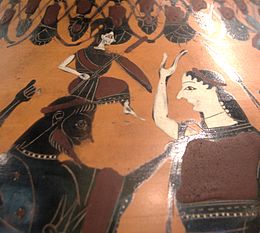
https://en.wikipedia.org/wiki/Athena
https://www.studyblue.com/notes/note/n/arth-exam-2/deck/10710897
      And this is Athena fighting the titans. The head was stolen.

After the battle was won, they decided who would rule the air, the sea, and the rest. So it was decided that Zeus would rule over the whole Gods, Hades over the Underworld, Poseidon over the Sea, Hera (Zeus's wife) as the protector of women and marriage, Hestia, the goddess of the hearth, as hearth was very important to the Greeks, because fire was really important back then, and Demeter, the goddesss of the harvest.


That's the end of the myth.


Wednesday, 12 August 2015

Red Bean Experiment

Activity 1.6

I have 4 red beans and I'm going to explore the inside of them. First I have to peel the skin off the red bean. The skin is called the testa. I have peeled two of the beans, and this is how they look like with the unpeeled beans. With the testa moved, then you can see the cotyledons, which are the creamy colored structures.


Then I open the cotyledon in the middle. I can see the embryo plant, which is the little thing at the top of the bean.


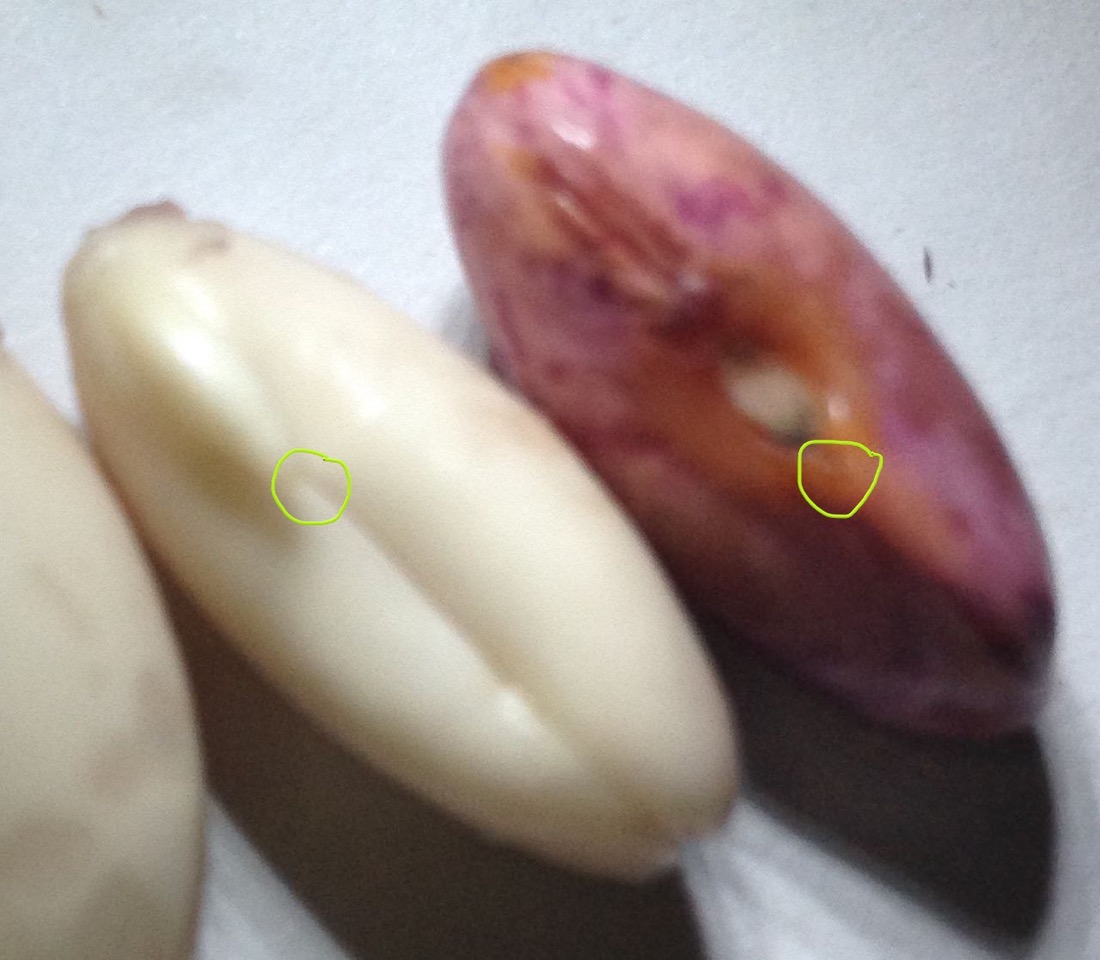
We can see the micropyle and scar in this zoomed photo. The yellow circles there show the micropyle. The scar is the circle in the middle of the red bean. Micropyle is a tiny hole where the pollen grew into an ovule and it allows the water absorption. The scar, or hilum is where the bean was attached to the plant's stalk during the development.